Bath & Wellness · 9 min read
Natural Stone in the Bathroom: Care, Myths and Which Stones Really Work
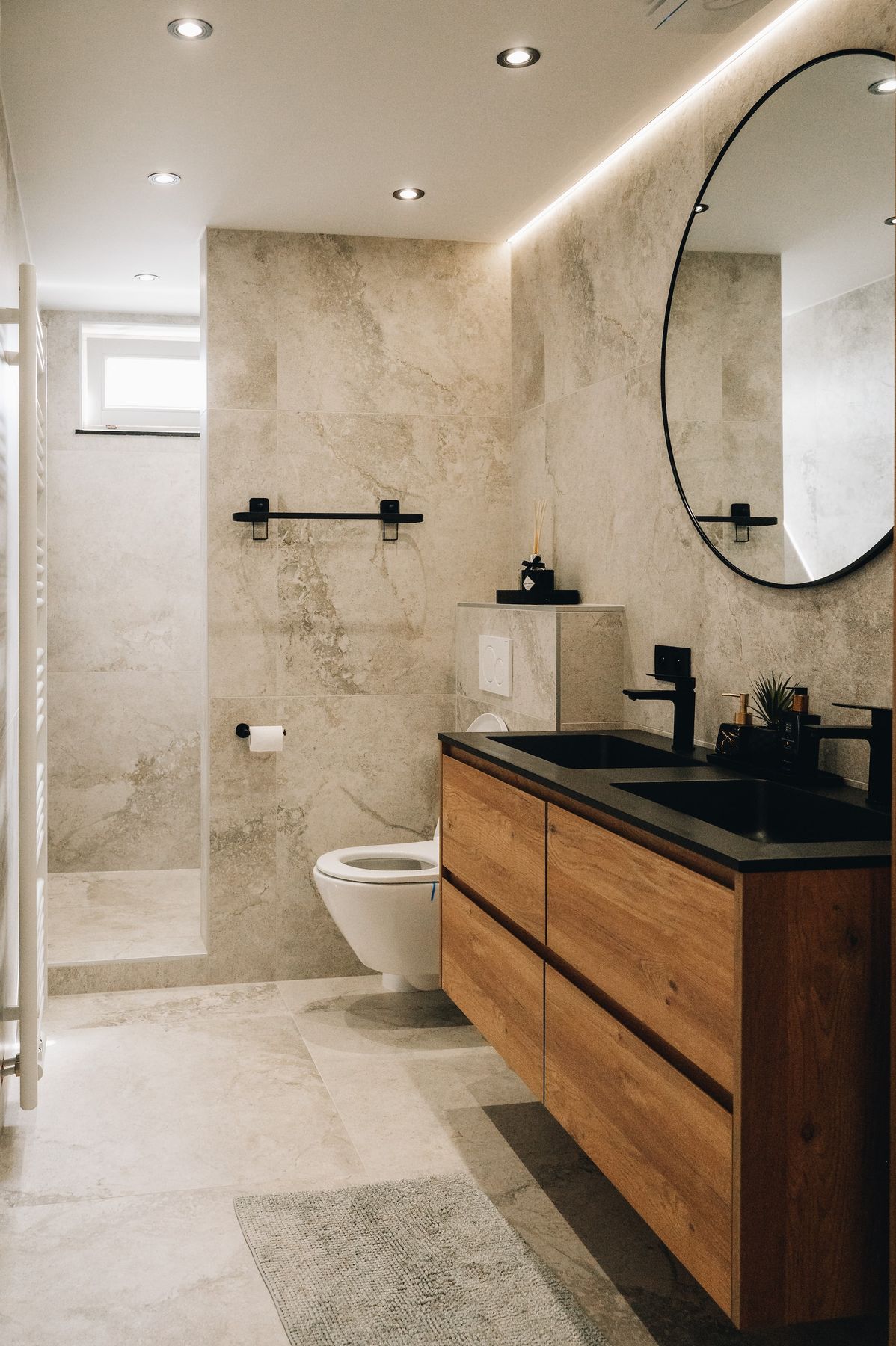
Your hand rests on a pale slab of marble in a showroom, cool and silky, while a voice in your head repeats what a friend told you: it will stain, it will etch, it will never look the same. Now imagine that same stone on the wall of your bathroom ten years later, with a soft sheen and a few fine marks that tell the story of your mornings.
Picture a couple in Döbling, both in their mid-forties, in a generous flat in a villa from the turn of the century. For the new bathroom they have a picture in mind: pale marble with fine grey veining, on the walls, at the vanity unit, in the shower. Their tile merchant advised against it, a friend told them of dull marks that never come out. And in a hotel in Milan they saw exactly this bathroom, flawless after years. Who is right? Both. The answer lies in the detail.
Contents
- Why natural stone is so special in the bathroom
- Limestone or silicate rock: the most important difference
- Five myths about natural stone in the bathroom
- The finish decides too
- Where in the bathroom which stone works
- Workmanship: adhesive, waterproofing and joints
- Everyday care: a short routine
- Frequently asked questions
- What happens next
Why natural stone is so special in the bathroom
No other material brings so much depth to a room. Every slab is unique, the veining runs across walls and floors, and the light changes the colour over the course of the day. Natural stone feels cool but not cold, and it ages with dignity if you let it.
In Vienna natural stone has a long tradition, from the marble in the stairwells of the Gründerzeit (the late nineteenth-century building boom) to the vanity tops of old hotel bathrooms. Many of these surfaces are over a hundred years old. They are not flawless, but they are beautiful. That is the first thought that helps with natural stone in the bathroom: it acquires a patina. The question is whether you want one. If you are embedding the decision in a larger bathroom plan, you will find the sequence in the guide to bathroom renovation in Vienna.
Natural stone is not a material that stays new. It is a material that ages well if you understand it.
Refusing stone out of caution has a cost too. You settle for an imitation that looks the same on the first day and the last, and you give up the depth you would have seen every morning for twenty years. Choosing the wrong stone costs just as much, only later. So the first question is a simple one: what is the stone made of?
Limestone or silicate rock: the most important difference
For the bathroom, one distinction is decisive: does the stone consist predominantly of lime, or of silicate minerals such as quartz and feldspar?
Calcareous stones such as marble, limestone and travertine react to acid. Even vinegar, lemon juice, acidic cleaners or descalers attack the surface. Dull patches result, known as etch marks. They are not dirt but a change in the surface itself.
Silicate stones such as granite, gneiss and true quartzite are considerably harder and more acid-resistant. They forgive more, but often have a different look, more grainy or more boldly patterned.
| Type of stone | Acid-sensitive | Hardness | Suitability in the bathroom |
|---|---|---|---|
| Marble | yes | medium | walls and vanity top very good, floor and shower with care |
| Limestone | yes | rather soft | walls good, shower only with careful maintenance |
| Travertine | yes | medium | walls and floor, pores filled or open |
| Granite, gneiss | hardly | high | everywhere, including shower and vanity top |
| Quartzite | hardly | very high | everywhere, material testing recommended |
| Slate | hardly | medium | floor and shower, naturally slip-resistant |
A tip from practice: not every stone sold as quartzite actually is one. Some trade names denote stones that are in fact marble. We therefore test samples beforehand with a simple acid and scratch test before they are approved for a bathroom. Which of the stories you have heard are true?
Five myths about natural stone in the bathroom
Myth 1: Natural stone is unsuitable for the bathroom
That is not true. Natural stone has been used in bathrooms for centuries. What matters is choosing the stone for the particular surface, the right finish and the care. A marble on the wall behind the vanity unit has entirely different demands from a floor in the shower.
Myth 2: Sealing makes the stone insensitive
A sealer penetrates the pores and reduces the absorption of water, oil and dyes. It therefore protects against stains. It does not protect against acid, because acid attacks the surface chemically. A sealed marble will still get etch marks if you treat it with a vinegar-based cleaner.
Myth 3: Marble is too soft and scratches immediately
Marble is softer than granite or ceramic, but not so soft that it scratches immediately in a bathroom. In daily life, scratches arise more from sand under shoe soles or hard objects on the vanity top. Honed, matt surfaces show such marks far less than polished ones.
Myth 4: Natural stone grows mould
Natural stone itself does not grow mould. Mould develops in joints, silicone and on soap residue when a bathroom is poorly ventilated. That affects ceramic just as much. How to get moisture under control through construction is described in the article on ventilation in the bathroom.
Myth 5: Natural stone is laborious to care for
Natural stone does not need more care than other surfaces, but different care. Instead of acidic bathroom cleaners, you use pH-neutral products or special stone soaps. Anyone who knows this finds natural stone no more laborious to care for in daily life than ceramic.
The finish decides too
The same stone looks and behaves very differently depending on its finish.
- Polished: Glossy, rich in colour, the veining stands out strongly. Etch marks and scratches are clearly visible, and the surface becomes slippery when wet. Well suited to walls, less so to floors and showers.
- Honed: Silky matt, calmer in appearance. Etch marks are less noticeable, and the surface is considerably less sensitive in daily use. Often the right choice for vanity tops and floors.
- Brushed: Lightly textured, pleasant underfoot, improved slip resistance. Good for floors and shower surfaces.
- Bush-hammered or flamed: Rough surfaces with high slip resistance. Flaming works only with silicate stones such as granite, not with marble.
So that wall, floor and vanity top fit together despite different finishes, a well-thought-out material concept helps. For the couple in Döbling, the decision fell on a pale marble with a honed finish for the walls and vanity top and a brushed version of the same stone for the floor. In the shower, the floor was laid in a silicate stone of similar colour that is barely noticeable but considerably more robust. Which stone belongs where?
Where in the bathroom which stone works
The load is not the same everywhere in the bathroom. These rules of thumb help with planning:
- Walls outside the shower: Almost any stone works here, even polished marble. The load is low.
- Shower walls: Well suited, as long as no acidic cleaners are used. A squeegee after showering prevents limescale deposits.
- Vanity top: Toothpaste, perfume, cosmetics and water meet here. Honed marble works if you accept marks as patina. Anyone who does not want that chooses granite, quartzite or Dekton.
- Bathroom floor: Honed or brushed finishes, sufficiently slip-resistant. Marble is possible; granite and quartzite are less sensitive. How stone fares against parquet, ceramic and terrazzo is shown in the comparison of floor coverings.
- Shower floor: The most demanding surface. Silicate stones with a textured finish are the safest choice here.
If you want to combine natural stone with other materials, the article on large-format ceramic in the bathroom has suggestions for calm surfaces. For the vanity unit we often work with stone slabs on a base from our joinery Tischlerkultur, a Viennese carpentry tradition begun in 1935, as described in the article on the made-to-measure vanity unit. But a stone is only as good as its laying.
Workmanship: adhesive, waterproofing and joints
Natural stone demands careful workmanship that differs from ceramic.
Pale marbles can be discoloured by grey cement adhesive, because moisture carries components of the adhesive into the stone. White, fast-setting specialist adhesives are therefore used for pale stones. Some stones, such as certain green marbles, are sensitive to water in the adhesive and can warp. Reactive-resin adhesives are used for them.
Waterproofing in the wet area is just as important with natural stone as with ceramic. How it is built up is described in the article on the walk-in shower. Joints are made with grout suitable for stone, and elastic joints with natural-stone silicone that does not discolour the edges.
Natural stone can be worked very finely today, with precise edges and the most varied finishes. Laying it in a bathroom requires craftsmen who have experience with the material. That is not a question of price but of knowledge. With us you have one contact person from the first sketch to the handover, so the stone, the adhesive and the waterproofing are agreed in one place.
The stone is nature. The workmanship is craft. Both must be right.
Everyday care: a short routine
Caring for natural stone in the bathroom is simpler than its reputation suggests. This routine is enough in most cases:
- After showering: Draw the water off walls and glass with a squeegee. This prevents limescale rings and is the single most important measure.
- Weekly: Wipe with a pH-neutral cleaner or a stone soap. Stone soap leaves a fine protective film.
- Immediately after spills: Wipe off perfume, nail-polish remover, hair dye or acidic cosmetics at once.
- Never: Use vinegar, citric acid, descalers or abrasive products on calcareous stones.
- Every one to three years: Renew the sealing, depending on the stone and wear.
- For etch marks: A stonemason can often re-grind honed surfaces and so restore the original finish.
The couple in Döbling internalised this routine after a few weeks. A squeegee hangs in the shower, and in the cupboard there is stone soap instead of bathroom cleaner. After two years the vanity top shows a few fine marks that you see only in raking light. The two say that it comes with the territory.
If you are looking for a lower-maintenance alternative with a stone look, you will find it in ceramic or in Cosentino Dekton. The comparison between the materials is described in the article on low-maintenance surfaces. You can find out more about our work on bathrooms on the pages bathrooms and bathroom renovation.
Frequently asked questions
Which natural stone is best for the bathroom?
For heavily used surfaces such as shower floors, silicate stones such as granite, gneiss or true quartzite are the most suitable, because they are hard and acid-resistant. Marble and limestone work very well on walls and vanity tops, but require acid-free care. The choice depends on the surface and the look you want, and we help you make it.
Can marble be used in the shower?
Yes, marble can be used in the shower, especially on the walls. It must not be treated with acidic cleaners or descalers, though, and the water should be drawn off after showering. For the shower floor, a brushed marble or a more robust silicate stone is advisable. A squeegee in the shower is all the effort it takes.
Does sealing protect against limescale and acid?
A sealer reduces the absorption of water, oil and dyes and so protects against stains. It does not protect against acid, because acid chemically attacks calcareous stones. Against limescale, what helps most is regularly drawing off the water.
How do you clean natural stone in the bathroom?
With pH-neutral cleaners or special stone soaps. Vinegar, citric acid, descalers and abrasive products are taboo for marble, limestone and travertine. A squeegee after showering is the most effective measure against limescale deposits. The routine takes only minutes a week.
Can etch marks on marble be removed?
On honed surfaces, a stonemason can often remove etch marks by re-grinding. On polished surfaces, re-polishing is also needed. That is why honed surfaces are usually the easier-care choice in the bathroom, and why a mark is rarely the end of the story.
Is natural stone slippery in the bathroom?
Polished natural stone becomes slippery when wet and is therefore unsuitable for shower floors. Brushed, bush-hammered or flamed surfaces offer considerably more slip resistance. A textured finish should always be chosen for shower surfaces.