Materials · 9 min read
Real Wood in Interior Fit-Out: Oak, Walnut, Ash and How Wood Grows More Beautiful
Your palm rests on a plank of oak, and you feel the grain like a map under your fingers. Now imagine the same wood fifteen years from now: warmer, softer, marked by a thousand ordinary evenings, and more beautiful than on the day it came into the room.
A Saturday morning in the workshop in Münchendorf. Three samples lie on the table: a pale oak, a dark walnut and an ash with a bold grain. In front of them stands a couple from Währing who are reorganising their Altbau apartment (the pre-1945 Viennese apartment building). Let us call them Clara and Martin. They want wood, that much is clear. In the kitchen, in the bedroom, perhaps as a bookcase. But which? And what will it look like in fifteen years? The answer begins with a sentence that has been heard in a joiner's family for generations: wood goes on living even after the tree has been felled.
Contents
- Why real wood in interior fit-out is different
- Oak: the reliable all-rounder
- Walnut: warm, dark and elegant
- Ash: pale, tough and lively
- The three species compared
- How wood moves: humidity and the Viennese climate
- Finishes: oil, lacquer or soap
- Wood in the overall concept: one species or several?
- Frequently asked questions
- What happens next
Why real wood in interior fit-out is different
Real wood differs from decorative foils and printed surfaces in one decisive respect: it has grown. Every board and every sheet of veneer is unique, with its own grain, its own colour variation and its own small irregularities. That is not a flaw but the reason wood feels so warm.
At the same time, wood reacts to its surroundings. It takes up moisture and releases it, it changes colour under light, it picks up marks of use. Anyone who chooses wood chooses a material that changes along with the home. The joinery Tischlerkultur, founded in 1935 by Leopold Dobrohruschka, has worked with wood for three generations, and the most important lesson from that is: whoever understands wood plans with these changes rather than against them.
Wood is the only material in the house that you do not just look at but can watch growing older.
Whether a piece of furniture is built from solid wood or from veneered boards is a question in its own right, which we answer in detail in the article veneer or solid wood. Here we are concerned with the timber species themselves, and first of all with the one almost everybody asks about.
Oak: the reliable all-rounder
Oak is the most widely used wood in high-quality interior fit-out, and for good reason. It is hard, hard-wearing and easy to work. Its grain is distinct but not restless, and it tolerates very different finishes, from almost white oiled to deeply fumed.
Oak contains tannic acid. That has practical consequences: in contact with iron and moisture it can discolour dark. We therefore use fittings and screws suitable for oak and make sure no steel swarf is left on the surface. The same tannic acid makes fuming possible: the wood reacts with ammonia and darkens in the upper layers without any colour being applied.
Over time, oak under light becomes slightly warmer and darker, taking on a faint honey tone. Fumed oak changes less. Anyone who chooses a very pale oak should know that it will not stay that pale permanently, unless the finish contains light protection or a slight pigmentation.
Depending on the cut, oak shows a very different picture. In the so-called flat-sawn cut, arched, lively patterns appear. In rift-sawn or quarter-sawn cuts the growth rings run straight, and the fine, glossy medullary rays known as "mirrors" show up. For calm, large wardrobe fronts we often choose a straight cut. And if the room should feel darker and more collected?
Walnut: warm, dark and elegant
Walnut is the wood for rooms that should feel collected and warm. Its colour ranges from light brown to a deep chocolate, often with violet or grey nuances. In interior fit-out, American walnut is frequently used, which is more even. European walnut is rarer and usually more lively in its figure.
Walnut is somewhat softer than oak but hard-wearing in furniture making. The grain is fine and flowing, which makes it especially beautiful on large veneered surfaces. In libraries, dressing rooms and bedrooms it creates a calm that pale woods do not reach. Picture a bookcase wall in walnut on a winter evening, lit from below, the spines glowing against the dark wood. How a bookcase in walnut or oak is planned is described in the article on the home library.
In ageing, walnut behaves differently from oak: under light it tends to become paler and more golden brown, and the initially very dark areas even out. Many people see this as a gain, because the wood then looks softer and livelier. Anyone who wants to keep the dark tone should avoid hours of direct sunlight or choose a finish with UV protection.
Ash: pale, tough and lively
Ash is the paler counterpart of oak. Its grain is also pronounced, but the wood is lighter, almost cream-coloured, and therefore looks fresher. Ash is very tough and elastic, which is why it was traditionally used for tool handles and sports equipment. In interior fit-out this shows in robust edges and hard-wearing floors.
Under light, ash tends towards a slight yellow cast. With a suitable finish, such as an oil with pale pigment or a soap treatment, this effect can be softened. One variety is olive ash, in which dark, irregular heartwood zones produce a lively figure reminiscent of olive wood.
Compared with oak, ash is somewhat more sensitive to moisture. In bathrooms and at sinks we therefore use it only with a suitably protective finish and with care. So how do the three compare?
The three species compared
| Property | Oak | Walnut | Ash |
|---|---|---|---|
| Colour | light brown to warm, also fumed | medium to dark brown | very pale, cream-coloured |
| Grain | distinct, calm or lively depending on cut | fine, flowing | distinct, lively |
| Hardness in daily use | high | medium to high | high, very tough |
| Behaviour under light | darkens, becomes warmer | tends to lighten, becomes more golden brown | yellows slightly |
| Typical uses | floors, kitchens, wardrobes, tables | libraries, dressing rooms, bedrooms | furniture, light fronts, floors |
| Character | reliable, versatile | collected, elegant | fresh, Scandinavian |
Besides these three there are other woods that we use depending on the project. Cherry darkens strongly and takes on a reddish tone; maple is very pale and even but yellows noticeably. Which species suits always depends on the room and the light.
That is why choosing from a photograph is risky. A tone that looks perfect on a screen can feel cold at your window, and a surface that is too delicate shows every mark for years. You live with that choice every day, and nobody sells you a second floor. Wood in a home also has to survive the seasons.
How wood moves: humidity and the Viennese climate
Wood takes up moisture from the air and releases it again. In doing so it swells and shrinks, far more across the grain than along it. Solid wood reacts more strongly than veneered boards, whose construction largely compensates for the movement.
In the Viennese climate, indoor humidity fluctuates strongly. In summer the air is often humid; in winter, heating dries it out. In many Altbau apartments the relative humidity falls well below 40 per cent in January. Then small joints can open in solid wood, parquet strips show gaps, and large tabletops can warp slightly.
These tips help you live with wood in a relaxed way:
- Keep an eye on the room climate: A relative humidity of about 40 to 60 per cent is often recommended. A simple hygrometer shows where you stand.
- Adapt the construction: Solid wood panels need room to move. Good joiners plan for this, for example with breadboard ends or floating fixings.
- Acclimatise the wood: Before installation, wood should be stored in the room for some time so that it adjusts to the climate. With floors this is especially important.
- Not directly against radiators: Solid wood parts standing right next to heat sources dry unevenly.
If you are planning wood for the floor, you will find more in the comparison flooring: parquet, natural stone, ceramic and terrazzo. The last decision is the finish.
Finishes: oil, lacquer or soap
The finish determines how wood feels, how it ages and how much care it needs. There is no single right finish, only one that suits your daily life.
- Oiled wood feels natural and warm. The pores stay open, and the wood looks matt and alive. Small scratches can be repaired locally and re-oiled. In return the surface needs regular care, once to several times a year depending on use.
- Hard-wax oil combines the look of oil with somewhat more resistance to stains. It is a good compromise for kitchens and tables.
- Lacquered wood is more closed and easier to care for. Modern matt lacquers hardly look like lacquer any more. Larger damage is harder to repair locally, however, and often a whole surface has to be retreated.
- Soaped wood is a traditional treatment that keeps especially pale woods pale. It feels velvety but needs regular refreshing.
For kitchen fronts that are touched a lot, we usually recommend lacquer or hard-wax oil. For tables and floors that are allowed to be lived on, often oil. You will find more on fronts under kitchen fronts compared, and on how we build kitchens with timber fronts on the page about fitted kitchens.
An oiled oak table with twenty years of marks of use is more beautiful than one that looks as it did on the first day.
Wood in the overall concept: one species or several?
With Clara and Martin a typical question arises: should the whole apartment be in one species of wood, or may there be several? Our experience: one main species creates calm, and a second can set accents. More than two quickly becomes restless, especially if they lie in the same field of view.
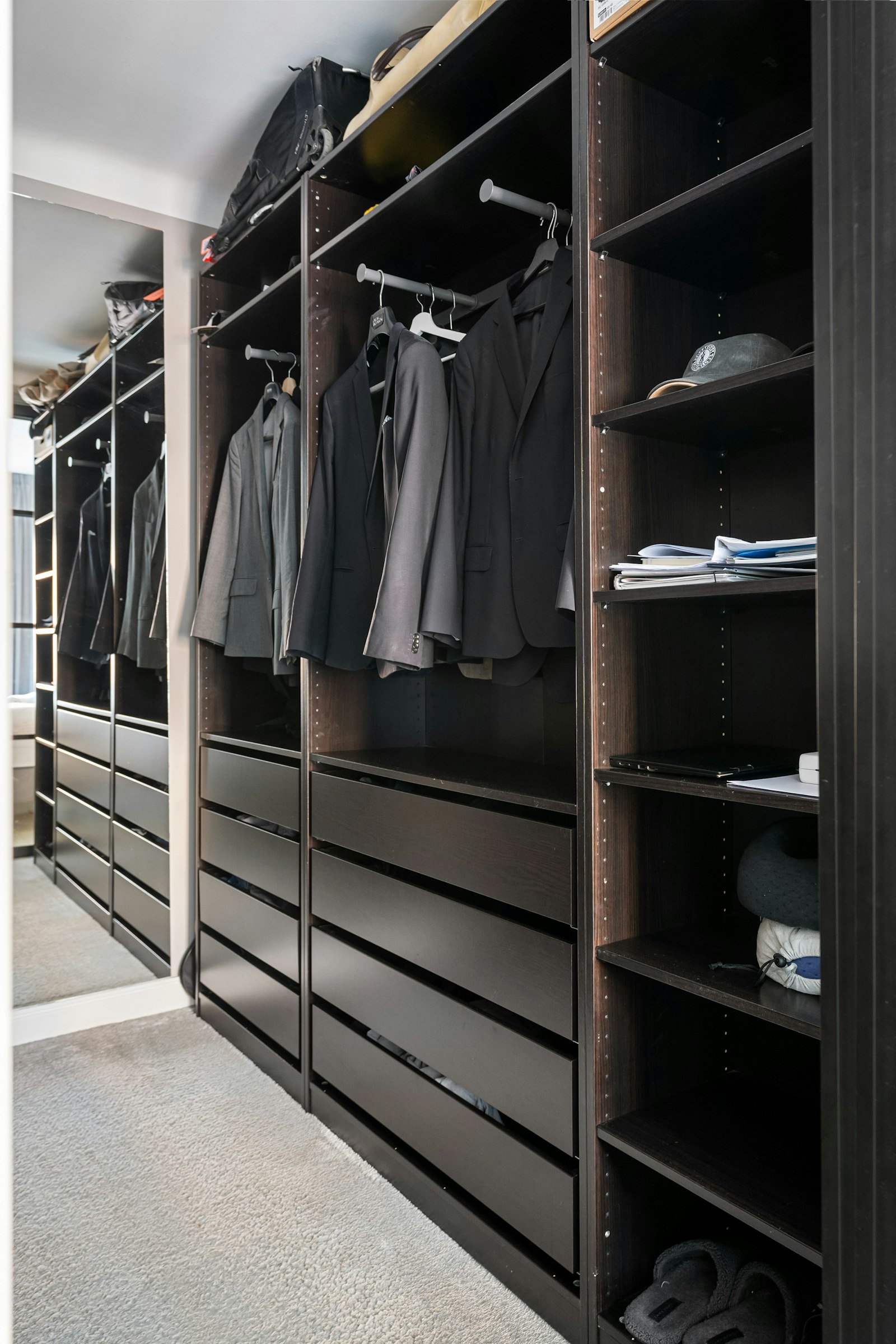
Clara and Martin decide on oak as the continuous wood, for the parquet and the kitchen fronts, and on walnut in the library and bedroom. The rooms with walnut lie behind doors, so both woods are rarely seen at the same time. How such a common thread is planned is described in the article the materials concept. We show floor-to-ceiling wardrobes in oak or walnut under fitted wardrobes.
The overall concept also includes the question of provenance. Wood from sustainably managed forests with traceable certification has become standard in high-quality interior fit-out. A piece of furniture that lasts thirty years is, moreover, more sustainable than one that is replaced after ten. More on this under sustainable means long-lasting. With us, one contact person accompanies the whole path, from the first sample on the table to the handover in your home.
Frequently asked questions
Which wood is the most robust for furniture in interior fit-out?
Oak and ash are among the most robust woods in interior fit-out. Both are hard and hard-wearing, and ash is additionally very tough. Walnut is somewhat softer but well suited to furniture and built-ins, and with sensible care it holds up for decades.
Does oak get darker over time?
Yes, oak darkens under the influence of light and becomes warmer in tone. Fumed oak changes less. A finish with light protection or slight pigmentation can slow the darkening. Most people find the warm tone a pleasure.
Does walnut get lighter?
Walnut tends to lighten under light and become more golden brown. The initially very dark areas even out over time. Anyone who wants to keep the dark tone should avoid prolonged direct sunlight.
Why do gaps appear in wood in winter?
Heating air lowers the humidity, and wood releases moisture and shrinks. As a result, small joints can open in solid wood and parquet, and these usually close again in summer. A relative humidity of about 40 to 60 per cent counteracts this. It is a natural movement, not a defect.
Is oiled or lacquered wood better?
That depends on use. Oiled wood feels more natural and can be repaired locally but needs regular care. Lacquered wood is easier to care for, but larger damage is more laborious to put right. In the initial call we help you find the finish that fits your daily life.
Can you combine different species of wood in one apartment?
Yes, in moderation. One main species and a second for accents or individual rooms usually look harmonious. More than two species in the same field of view quickly becomes restless.