Materials · 9 min read
Veneer or Solid Wood? The Honest Answer From a Joinery Workshop
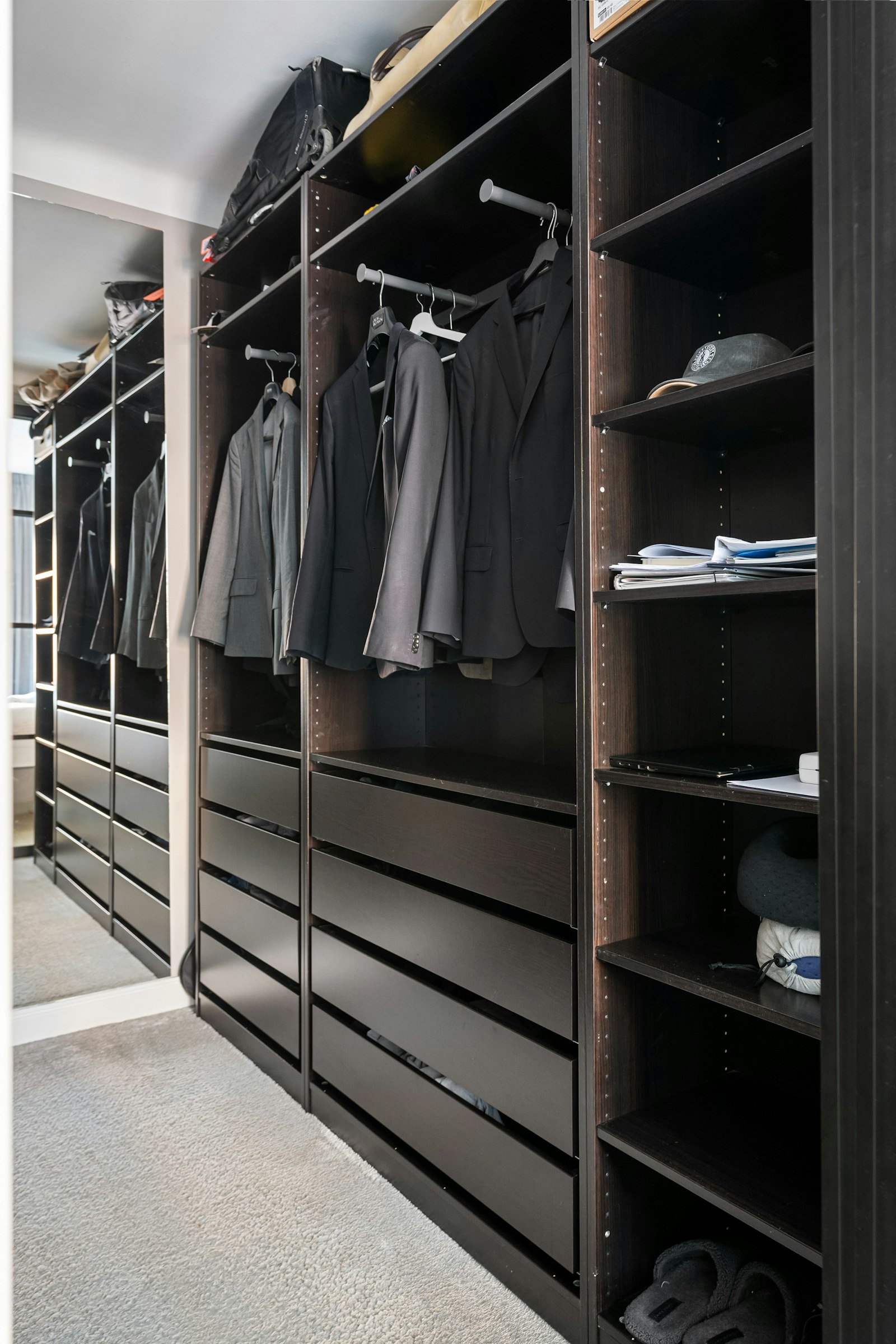
You run your hand along a wardrobe door, and ten years from now it should still close as cleanly as today. That depends less on the word "veneer" or "solid" than on what each construction does in your room. Imagine a couple from Baden moving into a Viennese Altbau apartment (the pre-1945 Viennese apartment building) with a ceiling height of 3.30 metres. In the bedroom a floor-to-ceiling wardrobe, six doors wide, is to be built. At the first appointment they say a sentence we often hear: "Solid wood only, please, no veneer." Behind it lies an understandable wish for quality, and an assumption that does not hold up on closer inspection. Let us call them Eva and Paul, and look into their question together.
Contents
What veneer and solid wood actually are
Solid wood means a component is wood all the way through. For larger surfaces it is usually glued from several narrow strips, because wide, flawless boards are rare and unstable. This is called glued-up timber or edge-glued panels.
Veneer is a thin sheet of real wood, cut or peeled from the trunk. The usual thickness is well under a millimetre; so-called thick veneer is heavier. The veneer is glued onto a carrier board, for example chipboard, MDF or plywood, and a balancing layer goes on the back so the board does not warp.
Both are real wood. The difference lies not in authenticity but in construction, and that construction decides how a component behaves when humidity and temperature change. How the individual species look and age is in the article real wood in interior fit-out.
So why does veneer have such a poor reputation?
The myth of cheap veneer
The idea of veneer as a budget version has a cause: there is a great deal of cheap furniture with thin veneer on weak carriers, badly glued, with plastic edges. That furniture has given veneer a bad name.
Yet veneer is one of the oldest and most demanding techniques in furniture making. The Viennese Biedermeier furniture that stands in museums today is largely veneered, in cherry, walnut or mahogany. The joiners of the time knew why: only veneer allowed large, calm surfaces with carefully chosen grain that stay dimensionally stable for centuries.
The question is not whether veneer or solid wood is better. The question is which construction does the right thing at which point.
In our joinery Tischlerkultur we work with both, in the Viennese carpentry tradition that has carried us since 1935. We would not sell anyone a veneered tabletop if solid wood were better, or the other way round. That is why we speak openly about the limits of both.
Start with where veneer wins.
Where veneer is superior
Large surfaces and tall fronts
A wardrobe 3.30 metres high in solid wood would have a problem: solid wood moves. Wide, tall doors would warp, cup or twist with the seasons. A veneered front on a stable carrier board stays largely straight, because the board construction compensates for the movement.
For Eva and Paul this is decisive. Six doors over three metres high are possible in solid wood only with great constructional effort and still with risk. In veneer they are a proven solution. How we plan such wardrobes is under made-to-measure fitted wardrobe or modular system.
Continuous grain
Veneer sheets are numbered and stored in the order they come off the trunk. Fronts can then be laid so the grain runs on across several doors, as if the wall were cut from a single piece of wood. This is sequence-matched veneer. It is not possible with solid wood, because every board comes from a different place. With floor-to-ceiling wardrobes in particular, this is the difference between a wall of six separate doors and one calm surface of wood.
Symmetrical patterns arise too: in book-matching, two consecutive sheets are laid as mirror images. That gives the calm, almost graphic surfaces known from high-quality dressing rooms and wall cladding. Examples are in the article planning a walk-in dressing room.
Resources and rare woods
From one trunk, veneer yields many times the visible timber surface that solid wood does. That conserves resources and makes rare or especially beautifully figured woods usable in the first place. More on material and longevity under sustainable means long-lasting.
But solid wood has its own, equally real strengths.
Where solid wood is superior
Repairability
Solid wood can be sanded down, several times, over decades. A stain, a scratch, a burn mark vanishes under the sandpaper. Veneer tolerates only careful, limited sanding, because the wood layer is thin. Once it is sanded through, the carrier shows.
Tables and worktops
For dining tables, desks and timber worktops, solid wood is usually the better choice. These surfaces are used daily, pick up marks, and are meant to. A solid oak table will be more beautiful in twenty years than today. How a table becomes the heart of the house is described in the article on the dining room.
Edges, handles and everything you touch
Edges are the most vulnerable point of any piece of furniture. On high-quality veneered parts we therefore fit solid wood edging, so-called lippings. They protect the board and, like the rest of the solid wood, can be reworked. Handle rails, handrails and the leading edges of shelves are also usually solid with us.
Feel and weight
Solid wood feels different. It is heavier, sounds more muffled and conveys substance. For furniture you touch, carry and use, that is a real value.
Imagine the wardrobe in your bedroom in five years: six doors closing with a soft click, grain running unbroken from one door to the next, and beneath your hand the edge, solid, slightly warm. Veneer and solid wood side by side give this feeling.
A comparison at a glance
| Criterion | Veneer on carrier board | Solid wood |
|---|---|---|
| Dimensional stability | very high | lower, wood visibly moves |
| Large surfaces and tall doors | very well suited | only with constructional effort |
| Continuous grain | possible, even across many fronts | not possible |
| Repair by sanding | only limited | possible several times |
| Edge protection | via solid wood lipping | inherently robust |
| Weight | lower | higher |
| Timber used per surface | low | high |
| Typical uses | wardrobe fronts, wall cladding, dressing rooms, kitchen fronts | tables, worktops, edges, handles, staircases |
The table shows differences, not winners. How do you tell good work from poor?
How to recognise good quality
Whether veneered or solid, quality shows in the details. We look at these points ourselves, and you can too.
- The edge: Is it solid wood or a strip of real wood, or plastic? Does the grain run cleanly over the edge?
- The veneer thickness: A somewhat thicker veneer tolerates more use and a light re-sanding. Ask.
- The carrier: A plywood or high-quality MDF board is more stable and moisture-resistant than a simple chipboard.
- The balancing layer: Veneered boards also need a covering layer on the back. If it is missing, the board can warp.
- The veneer layout: Do the grains run together across several fronts, or is every door different?
- With solid wood, the construction: Can a tabletop move, or is it rigidly screwed down? Rigid fixings lead sooner or later to cracks.
What doing nothing costs. A wardrobe chosen on a catalogue photo and a vague "solid wood is better" often means doors that warp in the first heating season and an edge that peels. You live with the gaps, then replace the piece, and pay twice for the same wall. The decision costs a conversation. The error costs a wall.
For kitchens the same rules apply, with extra attention to moisture at the sink and dishwasher. Open edges on carrier boards should be well protected there, because penetrating water makes the carrier swell. More under kitchen fronts compared and in the article kitchen from a joiner or a branded kitchen.
What does all this cost, then?
What the costs depend on
Many people expect solid wood to be more expensive than veneer as a matter of principle. That is often true, but not always. A high-quality veneered wardrobe with selected sequence-matched veneer, solid lippings and carefully coordinated fronts can contain more work than a plain shelf in solid wood. The price does not come from the word on the quotation but from material, effort and detail.
These factors determine cost most:
- Species and grading: A knot-free, calmly figured oak costs more than a rustic grading, and walnut usually more than oak.
- Veneer layout: Sequence-matched veneer across many fronts or a mirrored layout requires selection, planning and more waste.
- Edge construction: Solid lippings are more laborious than simple veneer edges but last considerably longer.
- Finish: Several coats of oil or lacquer with intermediate sanding take time but feel better.
- Construction: Solid wood that is allowed to move needs well-thought-out joints. That is craft, not mass production.
We name concrete amounts only once a room has been measured and the material chosen. Anything else would be a number without a basis. More important than the price per linear metre is how long a piece of furniture lasts. A wardrobe that closes for thirty years is cheaper in the end than two that last fifteen years each.
The solution for Eva and Paul
At the end of the second appointment the plan for Eva and Paul looks like this: the six tall doors are veneered in oak, in sequence-matched veneer, so the grain runs across the whole wall. The edges receive solid oak lippings. The handle rails are solid, as is the window seat in front of the window, which joins directly onto the wardrobe.
Eva runs her hand over the door and then over the bench. She feels no difference in the wood, only in the task it has.
This combination is no compromise. It is the construction an experienced joiner would choose for this task. The veneer ensures the doors still close straight in twenty years. The solid wood ensures that the places you touch every day may carry marks of use and can be refreshed. How such wardrobes from our workshop look is on the page about fitted wardrobes.
For the bookcase in the living room that the couple plan later, the same logic applies: veneered sides and back panels, solid leading edges on the shelves. More in the article on the home library.
Frequently asked questions
Is veneer inferior to solid wood?
No. Veneer is a construction method of its own, often better suited than solid wood to large, dimensionally stable surfaces. What is inferior is badly made furniture with thin veneer, weak carriers and plastic edges, not veneer itself. In a well-made piece you will not regret either.
How thick is veneer?
Usual veneer is well under a millimetre thick. Thick veneer is heavier and tolerates more stress as well as a light re-sanding. The right thickness depends on the use, and we advise you case by case.
Can veneered furniture be sanded?
Only to a limited degree. A careful, light sanding is usually possible, but heavy sanding as with solid wood is not. That is why we fit solid wood lippings on heavily used edges.
Why are tall wardrobe doors usually veneered?
Because solid wood moves, and large, tall doors can warp with changing humidity. Veneered boards stay largely dimensionally stable thanks to their construction, so the doors close cleanly even after years.
When should I choose solid wood?
For tables, worktops, handles, edges and staircases, wherever surfaces are used daily and are meant to be refreshed. Solid wood tolerates repeated sanding and ages beautifully in the process.
How do I recognise good veneered furniture?
By a solid or real wood edge, a stable carrier, a balancing layer on the back and a well-thought-out veneer layout. If the grains run together across several fronts, that is a sign of careful work.