Materials · 8 min read
Textiles in Interiors: How Curtains and Rugs Turn a Loud Room into a Calm One
At the first dinner with friends every word comes back twice, the cutlery clatters as if in a stairwell, and after two hours everyone is tired. Now imagine the same table in the same room, with the evening curtain drawn, a deep wool rug underfoot, and a conversation so quiet that you could hear a candle gutter.
Imagine a couple who have just moved into a converted attic apartment in Währing. Large glazed surfaces facing the terrace, an exposed concrete ceiling in the living area, a continuous oak floor, a white kitchen with an island. The apartment is beautiful, but it sounds like a stairwell. This is exactly where the work with textiles begins, and it has little to do with decoration.
Contents
- Why modern rooms echo
- Curtains: the largest movable acoustic surface
- Rugs: the floor that listens
- Upholstery and covers: acoustics you sit on
- Which fabrics for what: an overview
- Homeliness: what textiles do beyond acoustics
- Planning: what must be settled before the first fabric sample
- Thinking textiles and fitted furniture together
- Step by step to a quieter room
- Frequently asked questions
- What happens next
Why modern rooms echo
Contemporary architecture loves hard surfaces. Glass, concrete, stone, smooth plaster and large-format ceramic reflect sound almost completely. In an Altbau (the pre-1945 Viennese apartment building) with stucco, box-type windows and plenty of furniture, sound is broken up at countless edges. In an open, pared-back room it travels unhindered from wall to ceiling to window.
The result is called reverberation. Speech blurs because the reflections of the previous syllable are still in the room while the next one is already being spoken. People speak louder, so do the others, and the room becomes louder still. How this problem develops in open floor plans and which structural measures help is described in our article on acoustics in open-plan living.
A room can look perfect and still be tiring. You hear it before you understand it.
Many people simply accept it. They put it down to the evening, to the wine, to age. Yet every day a little of your energy goes into shouting over the room. Textiles are the obvious answer because they are porous. Sound penetrates the fibres, is converted there into tiny movements and thus into heat, and returns weakened. The thicker and more open the material, the more energy stays in the fabric. Where should you begin?
Curtains: the largest movable acoustic surface
In many apartments the windows are the largest hard surface. A curtain covering that surface therefore works twice over: it removes the reflection from the glass and brings absorbent material into the room itself.
Three things decide whether a curtain works acoustically. First, the weight of the fabric: heavy linen, wool, velvet or dense blended fabrics absorb markedly more than a light voile. Second, fullness: a curtain gathered to two to two and a half times the width of the window offers far more surface than one pulled taut. Third, the distance from the wall or the glass: an air cushion of a few centimetres behind the fabric noticeably improves the effect.
In practice we often combine two layers. A light, translucent layer filters daylight and protects against prying eyes. A heavy layer provides calm, warmth and acoustics in the evening. How daylight can be steered through fabrics, colours and reflections is covered in the article making the most of daylight. And what is underfoot?
Rugs: the floor that listens
A rug works above all against sound that originates right at floor level: footsteps, scraped chairs, children playing, a dropped toy. It also dampens the reflection between floor and ceiling, which is particularly strong in rooms with a hard floor and a smooth ceiling.
Size matters more than pattern here. A small rug in front of the sofa has hardly any effect; a large one, under which the front legs of the sofa and armchairs sit, defines a zone and noticeably takes out the echo. In the dining area the rug should be large enough that the chairs still stand on it when pushed back.
A good underlay almost doubles the benefit. It prevents slipping, protects the floor beneath and increases absorption. With parquet and underfloor heating we make sure that rug and underlay are suitable for this use. Which floor lies under the rug and how it sounds is the subject of our comparison of floor coverings.
Upholstery and covers: acoustics you sit on
In most living rooms the sofa is the largest soft mass in the room. A deep, upholstered sofa with fabric covers behaves acoustically quite differently from a slim leather one. Both have their place, but the decision should be made consciously.
Cushions, throws, upholstered headboards in the bedroom and fabric-covered benches add up. In a quiet bedroom they are part of what makes the room a retreat. More on how light, material and acoustics interact in the sleeping area is described in our piece on the bedroom as a place of rest.
Why the sofa often organises the whole room, not only acoustically but also in proportion and line of sight, is explained in the article on planning around the sofa. But which fabric does what?
Which fabrics for what: an overview
The following table is a guide from practice. The actual effect depends on weight, weave, fullness and distance.
| Textile | Acoustic effect | Effect on light | Care | Typical use |
|---|---|---|---|---|
| Voile, light linen | low | filters softly | washable | day curtain, privacy screen |
| Heavy linen | medium | clearly dims | usually washable | living room, bedroom |
| Wool fabric, felt | high | strongly darkening | dry cleaning | library, bedroom |
| Velvet | high | strongly darkening | dry cleaning | evening curtain, upholstery |
| Wool rug with pile | high | none | vacuum, professional cleaning | living, dining |
| Flat-weave | medium | none | easy | hallway, dining area |
| Fabric-covered panels | high | none | vacuum | wall surfaces, niches |
Natural fibres such as wool, linen and cotton usually age more gracefully than synthetics, but they are not automatically more robust. For households with children or pets there are blended fabrics and outdoor fabrics that look surprisingly homely.
Homeliness: what textiles do beyond acoustics
Acoustics can be measured; homeliness can only be felt. Yet the two are connected. A room that sounds quieter feels warmer, even if the thermometer shows the same. A curtain drawn in the evening transforms the room from an open daytime space into a sheltered evening one.
Textiles also bring colour and touch into pared-back rooms without making them restless. An apartment with oak, lime plaster and stone gains depth from a sand-coloured wool curtain and a warm grey rug. How a calm colour concept includes textiles instead of adding them afterwards as an accent is shown in the article of that name.
In the evening you draw the curtain, and the room moves closer. That is the moment textiles are planned for.
For our couple in Währing that was exactly the wish: in the daytime openness and a view across the rooftops, in the evening a room in which you can talk quietly. What must be settled before the first sample arrives?
Planning: what must be settled before the first fabric sample
The most common mistake with curtains is to think about them only after moving in. By then the track in the ceiling is missing, the pole sits too low and the fabric has no space to gather. The checklist we go through in the planning phase:
- Ceiling track or curtain recess: A track set into a suspended ceiling, or a curtain pocket, makes the curtain look like architecture. This has to be settled before plastering.
- Stack width: A heavy curtain pushed together needs space at the side. If that space lies in front of the glass, you lose daylight.
- Height: Floor-to-ceiling curtains stretch the room. They should end just above the floor or rest on it lightly, depending on the look you want.
- Motorisation: For large window fronts or skylights a motor makes sense. Cables and controls have to be provided for in the electrical planning.
- Rug zones: The size and position of the rugs determine furniture placement and floor outlets. A floor socket under a rug is annoying.
- Fire safety and use: In commercial premises, textiles are subject to their own requirements, which we agree with the manufacturer.
How to control motors and lighting scenes discreetly, without the apartment turning into a control centre, is described in our piece on smart home you don't see.
Thinking textiles and fitted furniture together
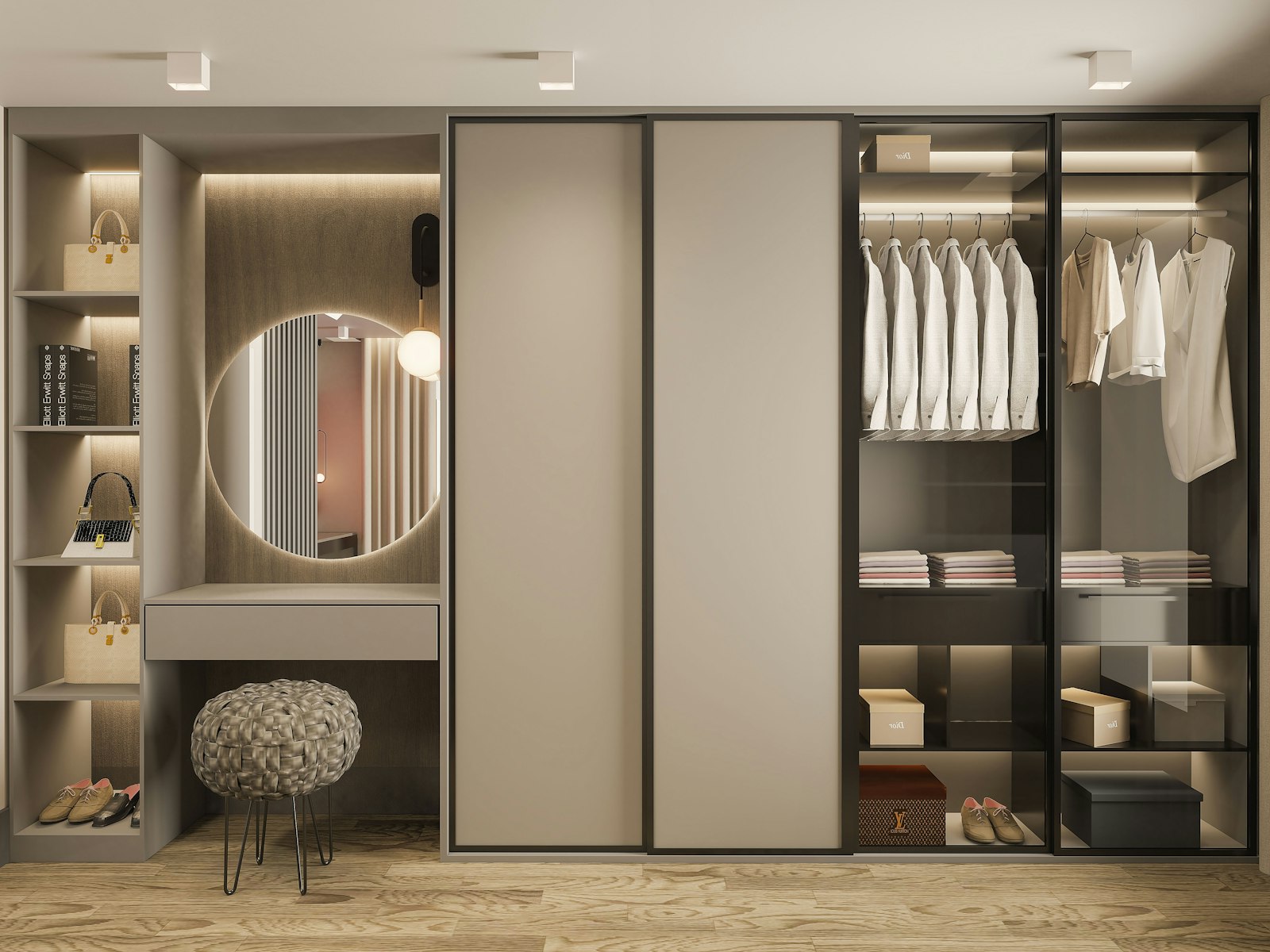
A large part of our work lies at the interface between fabric and joinery. A window seat that becomes a bench with an upholstered cushion. A bookcase wall whose niches are lined with fabric so that the library sounds calm. A fitted wardrobe with fabric-covered sliding doors that absorbs sound in the bedroom instead of throwing it back.
Because Richard Atelier plans and our joinery Tischlerkultur builds, such details can be solved in one go: the pocket for the curtain is drawn in the same plan as the wardrobe next to it. Behind this stands a Viennese carpentry tradition that began in 1935, and you have one contact person from the first sketch to the handover. You will find more on these possibilities on the page about fitted wardrobes. How a home library becomes a quiet room through textiles and wood is shown in our piece on the home library. What if the room is already finished?
Step by step to a quieter room
If a room is already finished and still echoes, a clear sequence helps. It achieves the biggest effect with the least effort.
- Cover the windows. A heavy, generously folded curtain in front of the largest glass surface is usually the most effective first step.
- Lay a large rug. It should take in the seating group or the dining table completely.
- Add soft furniture. Upholstered furniture with fabric covers, cushions, an upholstered headboard.
- Check the walls. Bookshelves and fabric-covered panels break up and absorb sound on wall surfaces.
- Consider the ceiling. Only if these steps are not enough is an acoustic ceiling solution worthwhile.
For the couple in Währing, the first three steps were enough, supplemented by a bookcase wall opposite the window front. The exposed concrete ceiling stayed exposed.
Frequently asked questions
Do curtains really improve room acoustics?
Yes, markedly, provided they are heavy enough, hang with sufficient fullness and sit a small distance from the wall or glass. A light fabric pulled taut has hardly any effect. Floor-to-ceiling curtains in front of large glass surfaces achieve the most.
How big does a rug need to be in a living room?
Big enough that at least the front legs of the sofa and armchairs stand on it. Small rugs have hardly any acoustic effect and make the room look restless. In the dining area the chairs should still stand on the rug when pushed back.
Which fabrics absorb sound best?
Dense, heavy and rather open-pored materials such as wool, felt, velvet or heavy linen. The more mass and surface a fabric has, the more sound it takes up. A good wool rug with an underlay is also among the most effective measures.
Can you work with textiles in a minimalist room without it looking cluttered?
Yes, if textiles are planned as a surface and not as decoration. A floor-to-ceiling curtain in a quiet tone and a large, plain rug reinforce clarity rather than disturb it. Many small cushions and patterns, by contrast, create restlessness. A calm room can be a soft one.
When should curtains be planned?
Before the ceiling is plastered, at the latest in detailed planning. Ceiling tracks, curtain recesses and motor connections must be settled by then. Anyone who plans only after moving in is left with visible poles and compromises. If your project is already under way, call us and we will look at what is still possible.
Do textiles make sense in homes with children or pets?
Especially there, because children and animals make noise. There are robust blended fabrics, washable covers and flat-weave rugs that stand up to a lot. The important thing is to choose materials that can be cleaned or replaced.