Living & Sleeping · 9 min read
Planning a Bedroom: Light, Materials and Acoustics for True Calm
It is 5.30 in the morning and the alarm goes off. You lie in the half-dark, a tram rumbles past, the laptop on the desk blinks its small green light, and the mirrored wardrobe returns your own tired outline. You both sleep badly and do not quite know why. The answer rarely lies in a single thing, but in the sum of many small ones. Now imagine the same room in the evening: warm light, a soft headboard, linen curtains drawn, and a silence that lets you drop off.
Take as an example a couple in Neubau, Vienna's 7th district, with a bedroom of 14 square metres facing the street, where the tram runs. He gets up early because his shift starts at dawn. She likes to read for another hour.
Contents
- What makes a bedroom calm
- Planning a bedroom: the bed first
- Light in the bedroom: dark, warm and controllable from the bed
- Acoustics and noise: how the bedroom becomes quiet
- Material and colour: calm you can feel
- Room climate: cool, fresh and not too dry
- Storage: closed, calm and easy to reach
- What does not belong in the bedroom
- Frequently asked questions
- What happens next
What makes a bedroom calm
A calm bedroom is a room that asks nothing of you. It does not remind you of work, of unfinished laundry, of the news. It is dark when you sleep, quiet when the city is loud, and pleasantly cool. That sounds simple, but in many apartments it is not the case.
The reason: the bedroom is often treated as a leftover room. What has no place in the living room ends up here. The desk, the ironing board, the clothes airer, the second television. The interior design of a bedroom therefore often begins with leaving things out.
A bedroom does not become calm by adding something, but by giving it back a single task.
What doing nothing costs. A restless bedroom costs you something every single night, even if you cannot say what. You wake earlier than you need to, you fall asleep late, and you start the morning already behind. Because the cause is a sum of small things, nothing ever seems bad enough to act on. That is why it pays to look at the room as a whole once.
Planning a bedroom: the bed first
The bed is the starting point of every bedroom plan. Its position determines how you feel in the room. Many people sleep more peacefully when they can see the door from the bed without lying directly in the line of movement. A position with a solid wall behind the headboard gives a sense of security.
A bed directly under a window, where it is draughty and light falls in early, or directly beside a radiator, is unfavourable. Clearances are just as important. Anyone moving about in the half-dark in the morning needs room without bumping into edges.
| Dimension | Minimum | Comfortable |
|---|---|---|
| Bed size for two | 160 × 200 cm | 180 × 200 cm or larger |
| Clearance at the side of the bed | approx. 60 cm | 70 to 90 cm |
| Clearance at the foot end | approx. 70 cm | 90 cm or more |
| Clearance in front of the wardrobe | approx. 80 cm | 100 cm or more |
These values are rules of thumb from practice. At 14 square metres they are easy to keep if the wardrobe is correctly positioned and there are no additional pieces of furniture in the room. An upholstered headboard is more than decoration: it makes reading in bed more comfortable and also dampens the room.
Two rhythms, one room
Many couples do not sleep to the same rhythm. One gets up early, the other goes to bed late. One reads, the other finds it hard to fall asleep with a light on. A well-planned bedroom takes these differences seriously instead of forcing a compromise.
That includes separate reading lights with tightly focused beams that do not reach the other side of the bed, and bedside tables with their own switches. A bed with two separate mattresses and a shared headboard prevents every movement from being felt on the other side. Whoever gets up early should be able to lay out their clothes the evening before outside the bedroom, for instance in a dressing room or a cupboard in the hall. And the route to the door should lie on their side, so that they do not have to walk round the bed. Next comes the biggest sleep factor: light.
Light in the bedroom: dark, warm and controllable from the bed
Light affects sleep more strongly than almost any other factor. Two things are at stake: darkness at night and the right light in the evening and morning.
Blackout
For restful sleep, the bedroom should be truly dark at night. Street lamps, shop windows and early summer light disturb more than you would think. Blackout curtains that close well at the sides and top, or roller blinds with side guides, help. In Viennese Altbauten (the pre-1945 period buildings) with box-type windows, a blind can often be fitted elegantly between the window sashes. Anyone who likes the morning light combines blackout with a light linen curtain.
Artificial light
In the evening the light should be warm and dimmed, in the range of around 2,200 to 2,700 kelvin. A bright, cool ceiling light feels like an office. Better are indirect light, for instance behind the headboard or above the wardrobe, and two separate reading lights. That way she can read while he is already asleep.
It is important that the lighting can be controlled from the bed, including the light at the entrance. A guide light near the floor that switches on gently at night via a motion sensor makes the way to the bathroom possible without waking anyone. How lighting design works across the whole home is described in Lighting design for the home. Then sound.
Acoustics and noise: how the bedroom becomes quiet
In Vienna, many bedrooms face the street, the tram or the stairwell. Noise is then the biggest disturbance. Against noise from outside, the window above all helps. Old box-type windows can often be improved considerably with new seals and an overhaul, without losing their character. Where that is not enough, a window with higher sound insulation can make sense. In an Altbau we also clarify what the Hausverwaltung (the building's property management) and, where relevant, heritage protection allow.
Inside the room, softness brings calm. A large rug, curtains in heavy fabric, an upholstered bed and cushions take the echo out of the room. More on this in Textiles: how curtains and rugs control acoustics.
An often overlooked trick: the built-in wardrobe as a buffer. If it stands on the wall to the stairwell or the neighbouring apartment, its contents act like an extra layer of insulation. A tightly closing door with a seal to the hall reduces noise from within the apartment.
The quietest bedroom is not the one with the thickest wall but the one in which every element absorbs a little sound.
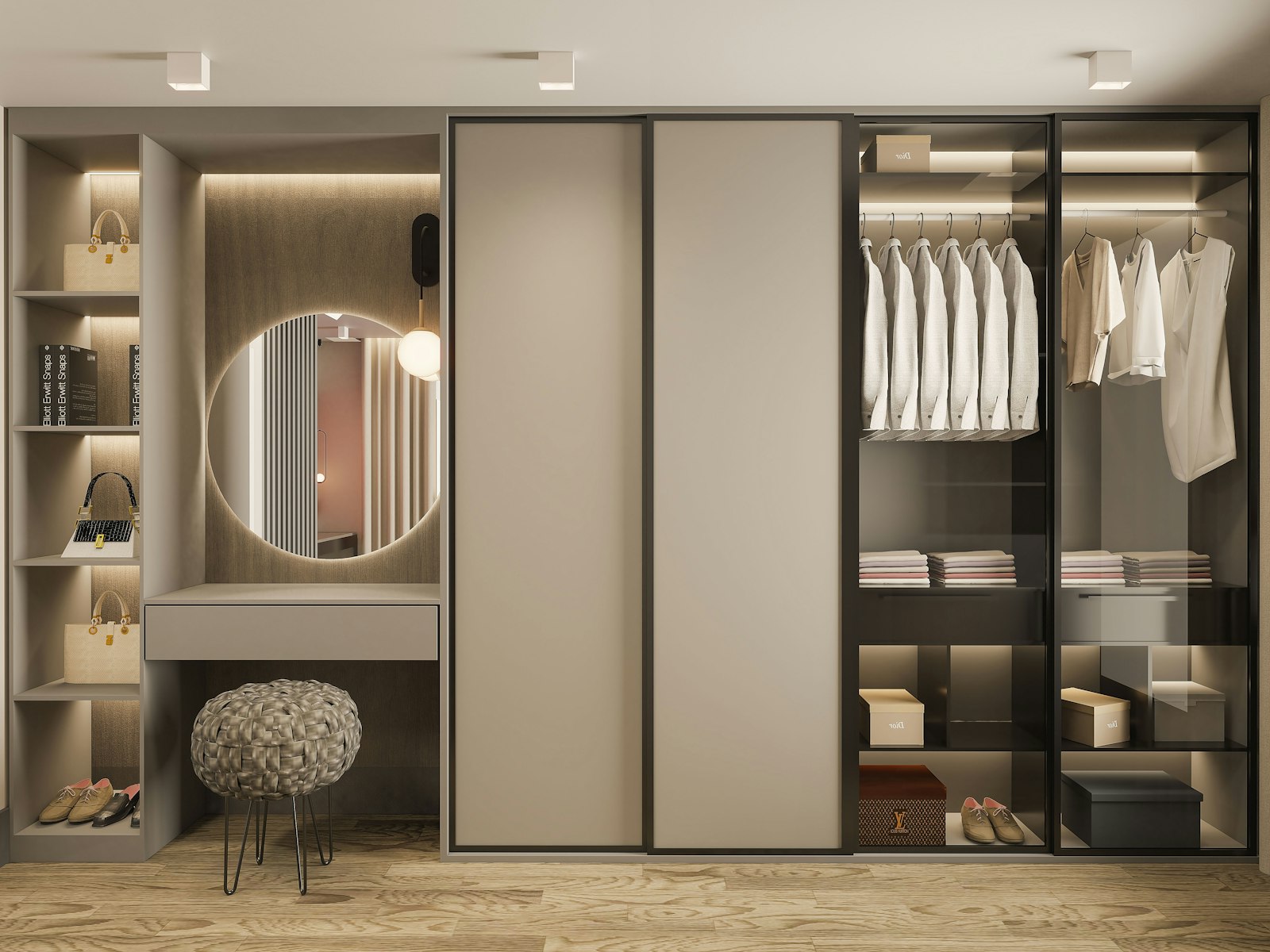
Picture it: you close the door of your made-to-measure wardrobe, which stands against the stairwell wall, and the sounds of the house fade. Our joinery Tischlerkultur, a Viennese tradition since 1935, builds such wardrobes to the millimetre, up to the ceiling, with no gaps to collect dust.
Material and colour: calm you can feel
In the bedroom you touch more than in any other room. Bed linen, the floor under bare feet, the headboard, the wardrobe door. Natural, matt and warm materials work particularly well here: oiled timber, wool, linen, cotton, a textile wall covering behind the bed.
Glossy surfaces and mirrors reflect light and movement and make the room more restless. Large mirrored doors opposite the bed are therefore among the things we usually replace. A mirror is better placed inside the wardrobe or in the dressing room. How different timbers develop is shown in Solid wood in interior fit-out.
For colours, muted, slightly broken tones help: warm grey, sand, soft green, a deep blue behind the headboard. Strong contrasts and bright colours keep you awake. The bedroom should nevertheless suit the palette of the rest of the home. How to achieve that is described in A colour concept for the whole home. Calm also depends on temperature.
Room climate: cool, fresh and not too dry
Many sleep researchers recommend a rather cool temperature for the bedroom, and a range of about 16 to 19 degrees is often cited. The humidity should not be too low; a range of about 40 to 60 per cent is considered comfortable. In well-insulated apartments and in a Viennese attic flat, overheating is more likely to be the problem in summer.
Here the question of technology is worthwhile. Surface heating that can also cool provides a pleasant climate silently, without draughts and without visible appliances. External sun protection keeps the heat out before it comes in. What surface systems can do is explained in Heating and cooling through surfaces. An air-conditioning unit in the bedroom should be especially quiet and should not blow directly onto the bed.
Storage: closed, calm and easy to reach
For many people, clutter is a quiet source of stress. Clothes on the chair, boxes on top of the wardrobe, charging cables on the bedside table. A calm bedroom therefore needs closed storage that takes in everything that accumulates in daily life.
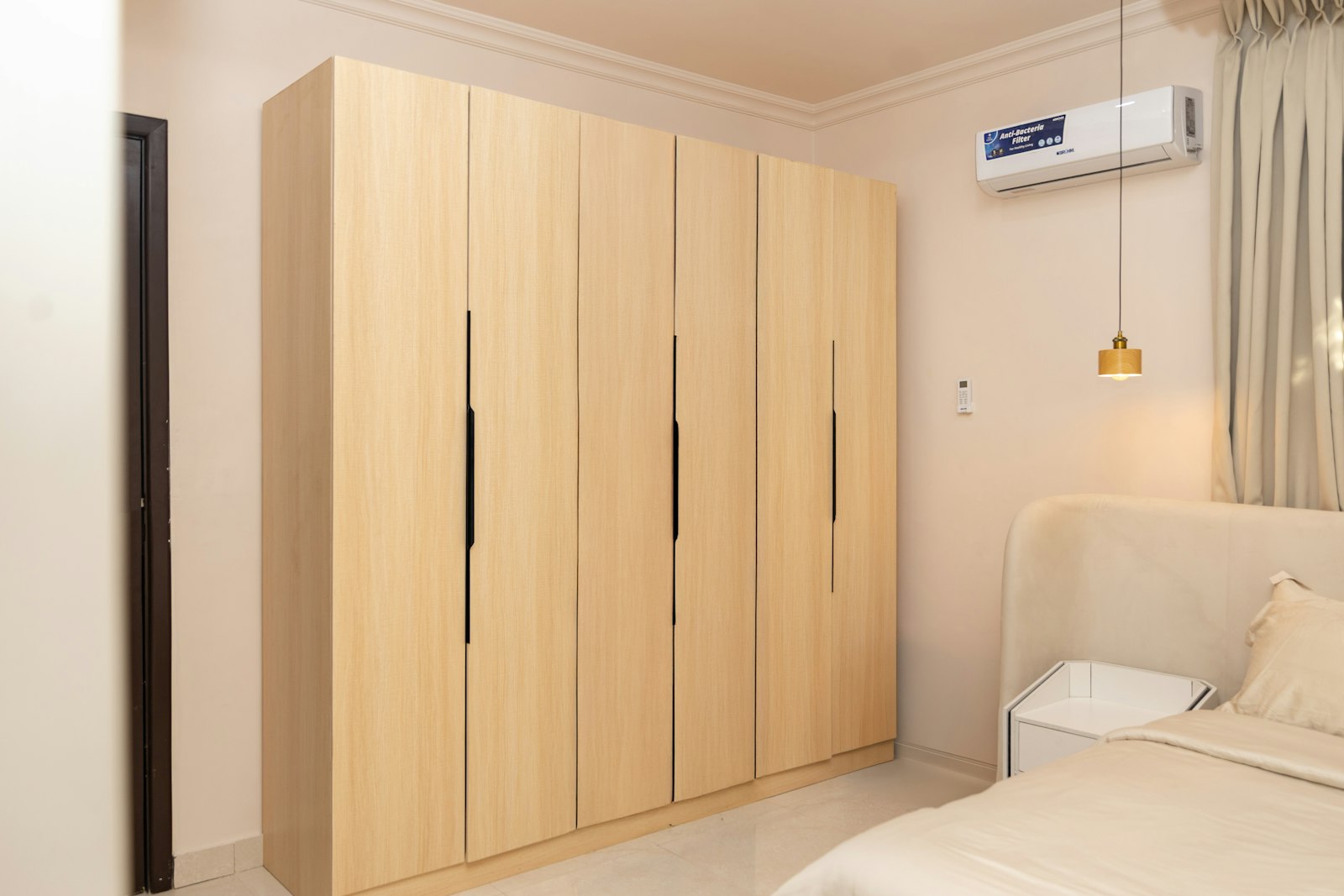
A made-to-measure built-in wardrobe uses the whole wall up to the ceiling and looks like a calm wall rather than a piece of furniture. Fronts without visible handles, or with recessed grips, reinforce this effect. Whether bespoke or modular is the right choice we discuss in Made-to-measure built-in wardrobe or modular system?. How we plan and make wardrobes can be seen on our page on fitted wardrobes and cabinets.
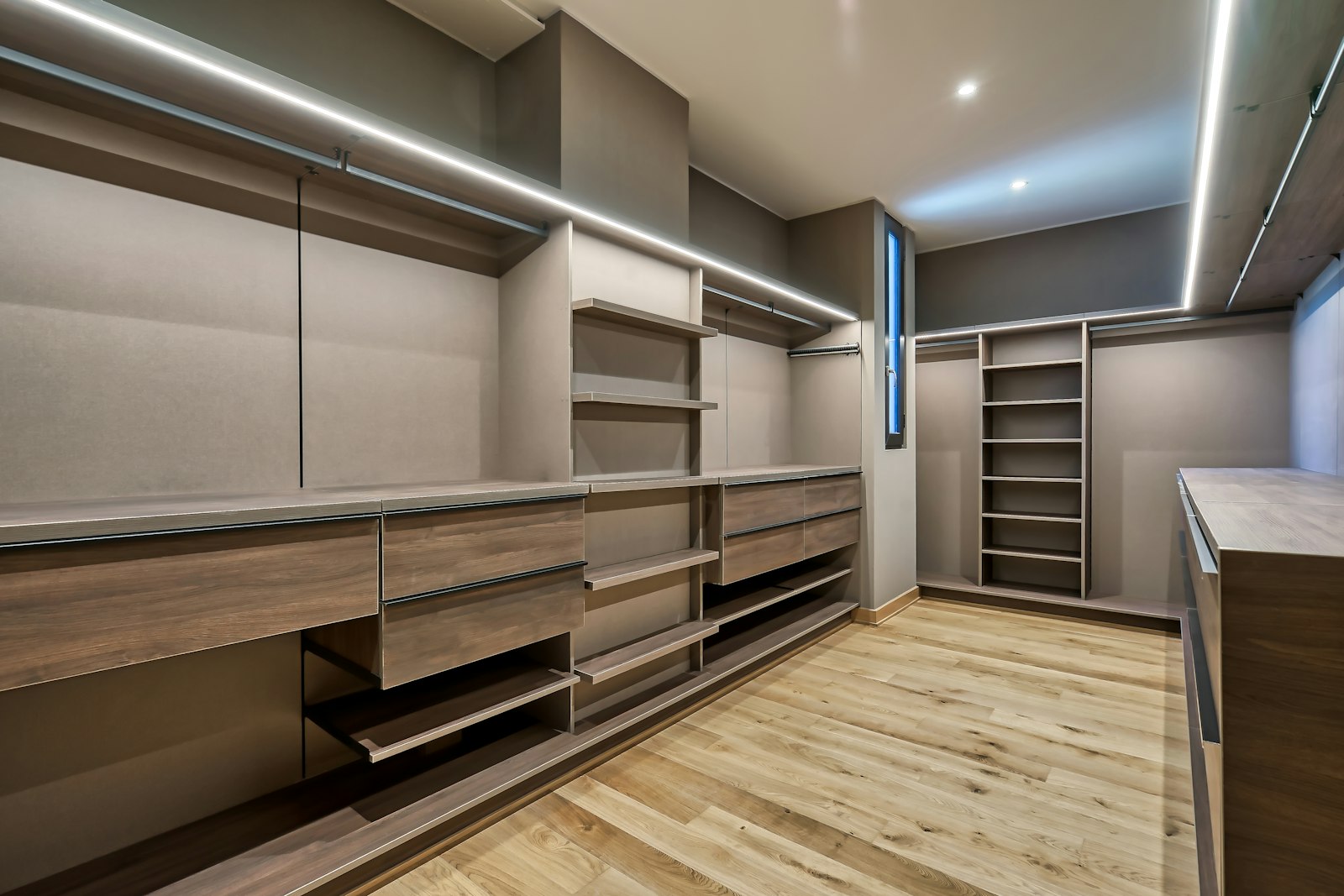
If you have the space, move the clothes out of the bedroom altogether. A dressing room between bedroom and bathroom removes a great deal of restlessness from the sleeping area, as Planning a walk-in wardrobe and Sleeping, dressing, bathing show. The bedside table also deserves planning: a drawer for things that should not be visible, and a socket for the phone so that no cable runs across the floor.
What does not belong in the bedroom
This checklist helps reduce the bedroom to its task:
- A desk with a laptop. If you work from home, there are better places in the apartment, as A home office in the apartment shows.
- A television opposite the bed, if it disturbs sleep.
- Clothes airer and ironing board. They need a place in the storeroom or in a cupboard.
- Open shelves full of things you do not want to look at.
- Large mirror surfaces opposite the bed.
- Cold, bright ceiling light as the only light source.
- Devices with luminous displays that blink during the night.
For the couple in Neubau a new room emerged from this. The desk moved into a niche in the living room, the television into the living area. The mirrored wardrobe was replaced by a built-in wardrobe in oiled oak on the wall to the stairwell. The bed now stands so that both can see the door, with an upholstered headboard and two separate reading lights. The box-type windows were sealed, and a blackout blind runs between the sashes. At 5.30 a.m. only a faint light glows near the floor, and in the evening she carries on reading without waking him. For the first time in months the alarm is the loudest thing in the room.
Frequently asked questions
How do I furnish a calm bedroom?
Reduce the room to sleeping and arriving, with a good bed position, closed storage and a few natural materials. Provide blackout, warm dimmable light and textiles that absorb sound. Workspace, ironing board and bright screens should if possible stand elsewhere.
Where should the bed be in the bedroom?
Many people sleep more peacefully when they can see the door from the bed without lying directly in the line of movement. A solid wall behind the headboard gives security. Positions directly under the window or beside the radiator are unfavourable.
What is the ideal light in a bedroom?
In the evening, warm, dimmed light of around 2,200 to 2,700 kelvin is suitable, ideally indirect. Add separate reading lights for each side of the bed and a floor-level guide light for the night. All lights should be controllable from the bed.
How can I make my bedroom quieter?
Against noise from outside, well-sealed or sound-insulating windows help most, and in an Altbau overhauling the box-type windows is often enough. Inside the room, rugs, heavy curtains and an upholstered bed dampen the echo. A built-in wardrobe on the wall to the stairwell also acts as a buffer.
What temperature should a bedroom have?
A rather cool temperature of about 16 to 19 degrees is often recommended, although personal preference varies. The humidity should ideally lie between about 40 and 60 per cent. In summer, external sun protection and quiet cooling systems help against overheating.
Which colours suit a bedroom?
Muted, slightly broken tones such as warm grey, sand, soft green or a deep blue are calming. Strong contrasts and bright colours tend to keep you awake. The colour should suit the palette of the rest of the home, so that the bedroom does not look like a foreign body.