Bath & Wellness · 9 min read
Bathroom Ventilation: Understanding Moisture and Ruling Out Mould by Design
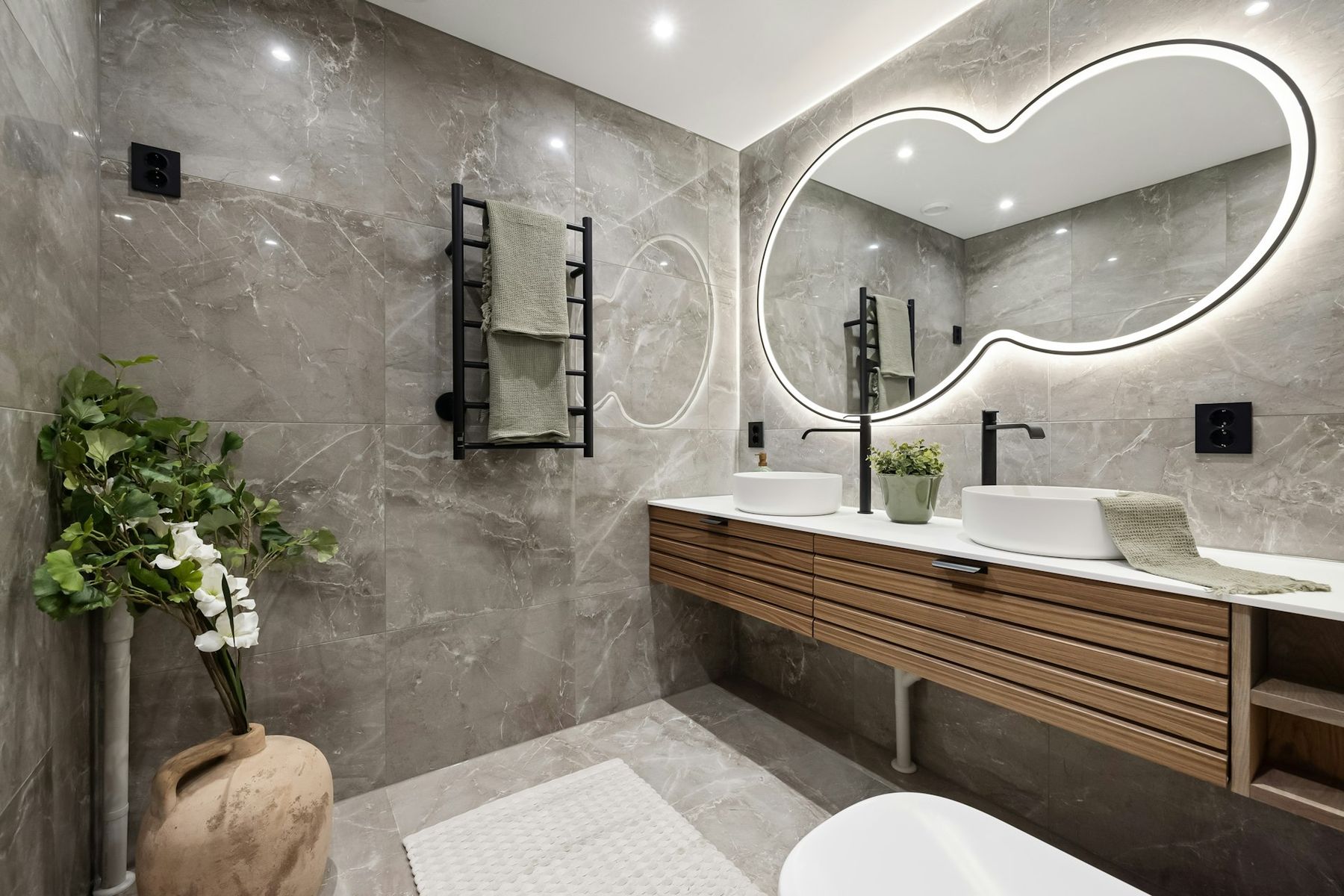
You have wiped the grey spot above the shower for the third time, this time with a stronger product, and it is already coming back. You are not careless. The problem does not lie in the surface, but in the air. Now imagine the bathroom after a long shower: the mirror clears within minutes, the corner above the tiles stays white, and nobody thinks about ventilation at all.
As an example, take the R. family: two adults, three children, an Altbau flat (a pre-1945 Viennese apartment building) in Rudolfsheim-Fünfhaus. The bathroom, renovated four years ago, is an internal room with no window, just an old ventilation grille in the wall. In the morning five people shower one after another, and in the evening there are baths. Since the second winter, grey spots have appeared in the corner above the shower, then on the silicone joint, then at the edge of the ceiling.
Contents
- How moisture arises in the bathroom
- Why mould forms: cold surfaces and time
- Window, fan or ventilation system: the options compared
- The internal bathroom: what a fan has to do
- The Viennese Altbau: shafts, gas boilers and the chimney sweep
- Constructional measures: surfaces, thermal bridges and joints
- Ventilating in daily life: a simple routine
- Frequently asked questions
- What happens next
How moisture arises in the bathroom
Every shower, every bath, every wet towel releases water into the room air. A four-person household puts several litres of water into the air every day through cooking, showering, breathing and laundry; ten litres or so is often quoted. A large part of that arises in the bathroom, in a small space and in a short time.
Warm air can absorb a lot of moisture, cold air little. After a shower the air in the bathroom is warm and almost saturated. When it meets a cooler surface, such as an external wall, a corner or a mirror, it cools there and releases water. The mirror fogs up. That is visible and harmless. On a wall the same thing happens, only less visibly.
Mould is not a cleaning problem. It is the visible end of a moisture problem.
What doing nothing costs. Wiping the same corner again and again feels like a solution. It costs time every week, it leaves a damp smell in the room and, if the moisture stays, the damage moves from the silicone into joints, plaster and the building behind them. A bathroom rebuilt without a ventilation plan simply repeats the problem in new tiles.
A relative humidity of about 40 to 60 per cent is regarded as comfortable and unproblematic. After a shower it rises well above that in the bathroom for a short time. That is normal. What matters is how quickly it falls again.
Why mould forms: cold surfaces and time
Mould fungi need three things: moisture, nutrients and time. They find nutrients almost anywhere, in soap residue, skin flakes, organic components of paints or silicone. The bathroom supplies the moisture. Poor ventilation supplies the time.
It becomes critical when moisture on a surface stays very high over several days; as a benchmark, a surface humidity of around 80 per cent applies. This happens above all in cool spots:
- External walls, especially in corners where two cold surfaces meet.
- Thermal bridges, for example at window reveals, ceiling junctions or uninsulated building elements.
- Behind furniture and mirror cabinets, where the air does not circulate.
- Silicone joints, which are constantly wet and contain organic components.
- Ceiling corners above the shower, where the humid air rises first.
For the R. family, all of this came together. The shower is on an external wall, the ventilation grille leads into an old shaft that barely draws, and the door closes tightly. The moisture from five showers in the morning simply had no way out. What are the ways to give it one?
Window, fan or ventilation system: the options compared
There are basically three ways of getting moisture out of the bathroom.
| Type of ventilation | How it works | Advantages | Limits |
|---|---|---|---|
| Window ventilation | Airing intensively after showering | simple, no technology | depends on behaviour, cool in winter, not possible in every bathroom |
| Extractor fan | draws humid air out via a shaft or external wall | reliable, even without a window | needs supply air and a suitable extract route |
| Whole-home ventilation with heat recovery | central or decentralised, continuous air exchange | even, energy-efficient | more planning and construction effort |
A bathroom with a window can be dehumidified well by airing intensively: after showering, open the window wide for a few minutes. A window left tilted for hours, by contrast, cools the reveal and can aggravate the problem. Many people, however, do not air consistently, especially in winter. That is why we often recommend a supplementary fan even in bathrooms with a window. And without a window at all?
The internal bathroom: what a fan has to do
In many Viennese flats the bathroom has no window. A mechanical extractor fan is then the rule. For it to really help, it should meet several requirements:
- Sufficient output: As a benchmark, 40 to 60 cubic metres per hour is often assumed for bathrooms, depending on size and use.
- Overrun: The fan keeps running after the light is switched off, usually for 10 to 20 minutes, so that the moisture from the shower is removed.
- Humidity sensor: It switches the fan on automatically when humidity rises and off again only once it has fallen. That makes the ventilation independent of behaviour.
- Trickle ventilation: Some units run continuously at a low setting and boost when needed. That keeps the bathroom evenly dry.
- Low noise: A loud fan gets switched off. Quiet units are accepted.
- Non-return damper: It prevents air or odours from flowing back from the shaft into the bathroom.
As important as the extract is the supply air. A fan can only draw out as much air as can flow in. With a tightly closing bathroom door with no gap, it works against a vacuum. A door undercut of about one to one and a half centimetres, or a ventilation grille in the door, remedies this. For the R. family, that was exactly the missing piece. Picture the effect: a quiet hum you hardly notice, the mirror clearing. But an Altbau has its own rules.
The Viennese Altbau: shafts, gas boilers and the chimney sweep
In a Viennese Altbau, bathrooms often vent into old ventilation shafts shared by several flats. These shafts do not always draw reliably; sometimes they are narrowed or have been altered. Simply connecting a fan to a shared shaft is not always permitted and not always sensible. We clarify this with the Hausverwaltung (the building management company) and the chimney sweep.
The question of the gas boiler is particularly important. Many Altbau flats have a gas boiler that draws its combustion air from the room, taking it from the flat. A powerful extractor fan can create negative pressure in the flat that pulls exhaust gases from the boiler into the living space. That is dangerous. Any mechanical ventilation in a flat with a gas boiler must therefore be agreed beforehand with the chimney sweep. Additional supply-air openings or safety devices are often required.
An alternative to the shaft is a fan through the external wall, provided the bathroom lies on one. In owner-occupied flats this usually requires the consent of the owners' association, because the facade is a common part. Which consents are needed for conversions in an Altbau is described in the article on permits in the Viennese Altbau. Further Altbau quirks are explained in the article on the bathroom in a Viennese Altbau.
Constructional measures: surfaces, thermal bridges and joints
Good ventilation is the most important measure. Constructional details make the bathroom more robust against moisture still.
Warm surfaces
The warmer a surface, the less condenses on it. Underfloor heating dries the floor quickly after showering. A heated towel rail dries towels and warms the air. With cold external walls, internal insulation can help, but it must be planned carefully in terms of building physics, because incorrectly executed internal insulation creates new problems. We check this with a building physicist.
Moisture-buffering materials
Outside the splash zone, mineral plasters such as lime plaster can temporarily absorb moisture and release it again. Mineral paints with a high pH value offer mould a poorer breeding ground than some emulsion paints. In the shower itself, by contrast, dense, sealed surfaces are needed. How the waterproofing is built up is described in the article on the walk-in shower.
Few joints
Joints and silicone are the preferred places for mould. Large-format slabs reduce the number of joints considerably, as described in the article on large-format ceramic in the bathroom. Silicone joints are movement joints. They should be made with sanitary silicone and renewed every few years, before mould takes deep hold.
Air behind furniture
Mirror cabinets and vanity units on external walls should be planned so that air can circulate behind them. A floating vanity unit set off from the wall has the advantage here. How to plan one is covered in the article on the made-to-measure vanity unit.
A dry bathroom is no accident. It is the result of air, warmth and the right materials.
This is where our approach differs. At Richard Atelier we plan ventilation, waterproofing, surfaces and furniture together, starting from the question of how you want to live in this room. The cabinets and the floating vanity unit come from our own joinery Tischlerkultur, a Viennese tradition since 1935, so that air circulates exactly where it should.
Ventilating in daily life: a simple routine
Even the best system benefits from a few habits:
- Keep the bathroom door closed while showering so that the moisture does not spread through the flat.
- After showering, squeegee walls and glass. That removes a large part of the water before it evaporates.
- Let the fan run or open the window wide until the mirror is clear again.
- Dry wet towels on the radiator; do not hang laundry in the bathroom.
- Do not let the room temperature in the bathroom drop sharply, even when it is not in use.
- Check silicone joints regularly and renew them at the first discolouration.
For the R. family, three measures were enough in the end: a quiet fan with a humidity sensor through the external wall, agreed with the chimney sweep and the Hausverwaltung, a door undercut for supply air, and new silicone joints. For two winters now, the corner above the shower has stayed white.
Existing mould, incidentally, should not simply be painted over. Small patches you can remove yourself; larger areas, as a rule of thumb from about half a square metre, belong in expert hands. If the cause is not fixed, it comes back. In a renovation we therefore plan ventilation, waterproofing and surfaces together from the start. More on this on the pages bathroom renovation and bathrooms and in the guide to bathroom renovation in Vienna.
Frequently asked questions
How do you ventilate a bathroom without a window properly?
A bathroom without a window needs a mechanical extractor fan, ideally with overrun or a humidity sensor. Equally important is sufficient supply air, for example through a door undercut or a ventilation grille. Without supply air, the fan cannot remove the humid air effectively.
How long should the bathroom fan run after showering?
As a guide, the fan should keep running for 10 to 20 minutes after showering. A humidity sensor is the better solution, because it lets the fan run until the moisture has actually fallen. In heavily used bathrooms, continuous trickle ventilation can make sense.
Why does mould form in the bathroom despite ventilation?
Common causes are missing supply air, an extract route that is too weak or draws poorly, and cold surfaces on external walls or thermal bridges. Permanently wet silicone joints and furniture directly against cold walls also encourage mould. A precise analysis of the cause matters more than stronger cleaning products.
May I connect a fan to the ventilation shaft in an Altbau?
That depends on the shaft and the building. Shared shafts may not always be used with fans, and particular caution is needed if there is a gas boiler in the flat. We clarify this beforehand with the Hausverwaltung and the chimney sweep.
What humidity is normal in a bathroom?
A relative humidity of about 40 to 60 per cent is regarded as comfortable. After a shower it rises well above that for a short time, which is normal. What matters is that it falls again within a short time.
Does underfloor heating help against mould in the bathroom?
Underfloor heating dries the floor faster after showering and keeps surfaces warm, which reduces condensation. It does not replace ventilation, though, because the moisture still has to leave the room. Combined with a good fan, it is a sensible addition.