Bath & Wellness · 9 min read
Planning Bathroom Lighting: See Yourself Properly at the Mirror
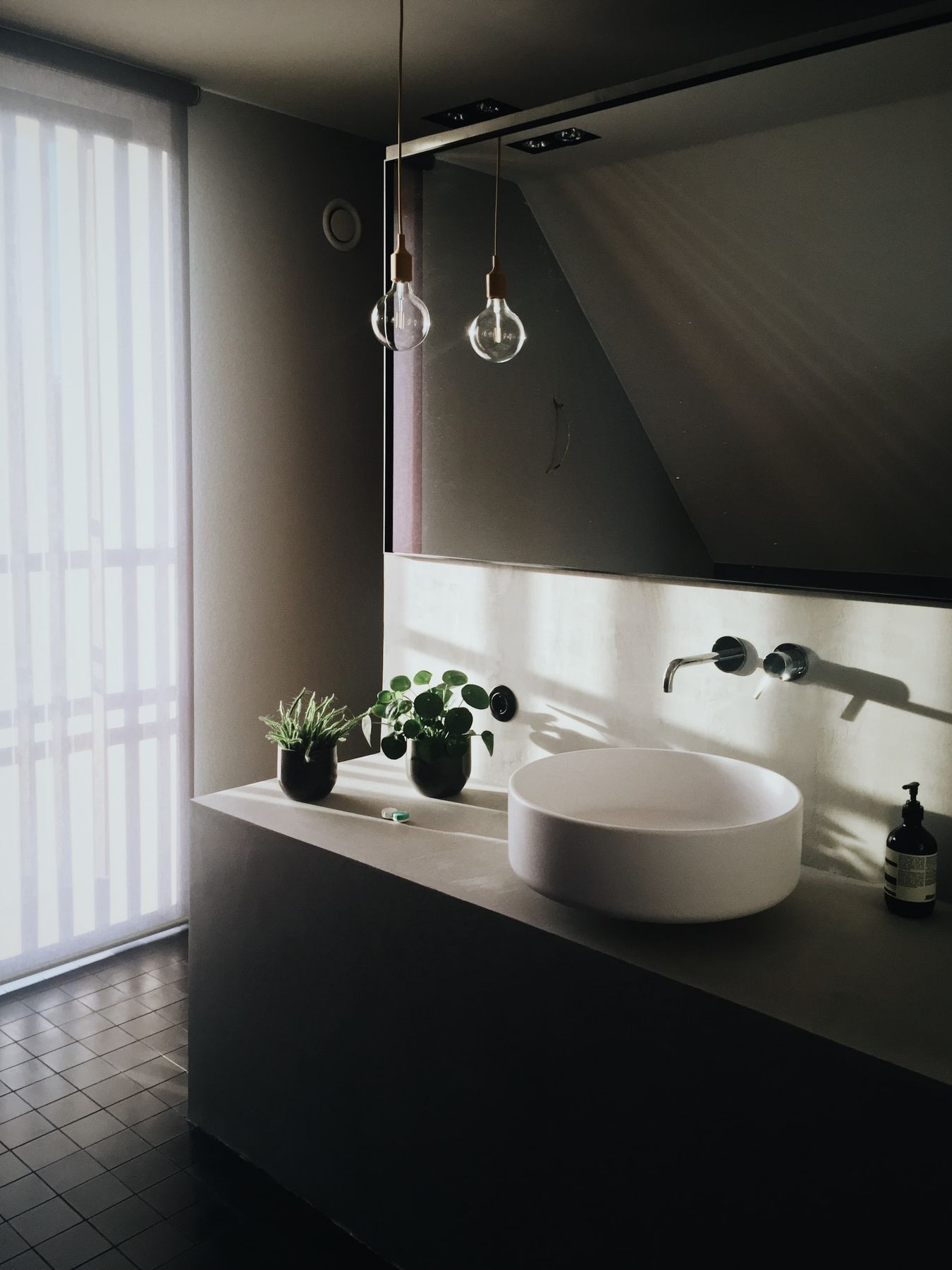
It is 6.15 on a January morning, and the bathroom has no window. You stand at the mirror with four spots shining steeply from the ceiling, shadows under your eyes, nose and chin, and only in the daylight at the office do you notice the make-up is too strong on one side. Now imagine the same minute with soft light from both sides, your face even and clear, and a dimmer to take the glare out of the evening. Take Mrs D., in a flat in Margareten. Her husband waits behind her with his razor and misses a patch on his right cheek. The bathroom is new. The light was an afterthought.
Contents
- Why the light at the mirror decides everything
- The four layers of light in the bathroom
- Planning the mirror light properly
- Ambient light and mood
- Light in the shower and niche: protection zones and safety
- Controls: switches, dimmers and night light
- Checklist for bathroom lighting
- Frequently asked questions
- What happens next
Why the light at the mirror decides everything
In the bathroom we look at ourselves. It sounds banal, but it is the core of every bathroom lighting scheme. We shave, put on make-up, check our skin, insert contact lenses. For that, the face needs light that comes evenly from the front and casts no harsh shadows.
The most common solution is the opposite: ceiling spots shining steeply from above. They light the floor well and the face badly. Every hollow becomes a shadow, every eyelid a dark patch. Apply make-up in that light and you apply it wrongly.
The most beautiful bathroom is of little use if you cannot see yourself properly in it in the morning.
At Richard Atelier we therefore plan light not as the last step but together with the floor plan, starting from the question "How do you want to live?" The fundamentals that apply to the whole home are in the article on lighting design for the home.
So what does a well-lit bathroom consist of?
The four layers of light in the bathroom
A well-lit bathroom has not one light source but several, each with its own task.
| Layer of light | Task | Typical position | Colour temperature as a guide |
|---|---|---|---|
| Mirror light | Light the face evenly | at the sides of and in front of the mirror | 2,700 to 4,000 K, good colour rendering |
| Ambient light | Light the room brightly and calmly | ceiling, indirect or diffuse | 2,700 to 3,000 K |
| Accent light | Emphasise shower, niches, materials | niche, shower, plinth | 2,700 to 3,000 K |
| Orientation light | Find your way safely at night | plinth, beneath the vanity unit | very warm, strongly dimmed |
These layers should be switchable separately. In the morning you mainly need the mirror light; in the evening in the bath, perhaps only the accent light. The same principle applies in the kitchen, as the article on kitchen lighting in three layers shows.
Take the first layer first.
Planning the mirror light properly
Position: from the sides rather than from above
The best light for the face comes from both sides of the mirror, roughly at face height. The face is then lit evenly from the front and shadows cancel out. Options are vertical luminaires to the left and right of the mirror, a light frame around it, or a mirror with integrated side light panels.
Light only above the mirror is a compromise. It beats ceiling spots because it sits closer to the face and shines more forwards. For precise tasks such as make-up it often falls short. With wide vanity units and two basins, each person needs their own mirror light. How to plan a double vanity unit is covered in the article on the made-to-measure vanity unit.
Brightness
At the mirror a considerably higher light level is needed than in the rest of the room. As a guide, about 300 to 500 lux at face height is recommended for tasks at the mirror. So that this does not feel too harsh in the evening, the mirror light should be dimmable.
Colour temperature and colour rendering
Colour temperature is given in kelvin. Warm-white light around 2,700 to 3,000 kelvin feels homely, while neutral white around 4,000 kelvin comes closer to daylight. If you apply make-up regularly, you benefit from more neutral light or from luminaires with adjustable colour temperature.
Colour rendering matters just as much, given as the Ra or CRI value. At least 90 ensures that skin tone, make-up and clothing look natural. Cheap LED strips often fall below this, and the face then looks pale or greenish.
Avoiding glare
Mirror light shines straight into the face, so the light sources must be well covered, for example by opal diffusers. Individual visible LED points dazzle and reflect unpleasantly in the glass. An evenly glowing surface is kinder.
For Mrs D. and her husband, two slim vertical light panels were fitted left and right of the mirror, dimmable and with adjustable colour temperature: neutral in the morning, warm in the evening. The missed patch on the right cheek is history.
Imagine that January morning again: the same dark window, but your face is calm, clear and the right colour, and the day starts without a second look in the office mirror. The room around it needs its own quiet light.
Ambient light and mood
Ambient light makes the room as a whole feel bright and pleasant. It should not dazzle, should cast no harsh shadows and should light the surfaces calmly. Indirect solutions work well: a light strip in a ceiling step, a cove above the mirror, or diffuse ceiling luminaires.
Downlights are possible but should be used selectively. A grid of many spots makes the ceiling restless. A few well-placed luminaires with a deep-set light source that do not dazzle are better.
For evening mood, accent light matters. A light in the shower niche, a strip beneath the floating vanity unit, or a light grazing a natural stone wall turns the bathroom into a calm room. Well-chosen luminaires become part of the architecture instead of decoration. More in the article on luminaires as part of lighting design.
In the morning the bathroom is a workplace. In the evening it is a retreat. The light has to be able to do both.
What doing nothing costs. Without a plan, you accept the shadow under your eyes every morning and the glare every evening, and you get used to both. The cost arrives later: a ceiling already closed, cables already in the wall, and a mirror light retrofitted where there is no room for it. Light is the one part of a bathroom that is cheap to plan and awkward to correct.
Water and electricity do not mix, so this next part needs care.
Light in the shower and niche: protection zones and safety
Special rules apply to electrical installations in the bathroom. Around the shower and bath there are protection zones in which only luminaires with the appropriate ingress protection against water are permitted. Safety extra-low voltage is often used there.
Which protection zones apply and which luminaires are permitted where is determined by the electrician in accordance with the applicable Austrian regulations. For planning that means: light in the shower is possible and beautiful, but must be coordinated with the electrician from the start. It can hardly be changed afterwards.
What has proved its worth:
- A downlight above the shower with sufficient ingress protection, ideally with warm, not too bright light.
- A light strip in the shower niche, which illuminates bottles and soap and highlights the niche as a design element.
- Indirect light behind a glass screen or on the shower back wall, which widens the room.
The mirror itself can carry technology. A mirror heater stops it fogging up after showering and is usually coupled to the light or to a separate switch. Where its cables must run belongs in early electrical planning.
How do you switch all of this on, without a wall of buttons?
Controls: switches, dimmers and night light
Light is only as good as its control. In the bathroom a simple logic has proved its worth:
- A switch at the door for the ambient light, so that you have light immediately on entering.
- A switch at the mirror for the mirror light, easy to reach and with a dimming function.
- A separate circuit for accent light, so that in the evening you can switch on only that.
- An orientation light with a motion sensor, which switches on automatically and very faintly at night.
- Coupling of the fan to the light or to a humidity sensor, so ventilation is not forgotten.
The orientation light deserves attention. Anyone going to the bathroom at night does not want bright light. A faint, warm light near floor level, for example beneath the vanity unit or in a plinth, is enough. It helps you fall asleep again afterwards and is a simple precaution for older people.
Picture the night: you wake at three, your feet find a soft warm glow at floor level, and the way to the bathroom is clear without a single switch.
If you want more comfort, light scenes can be controlled by a smart-home system. That makes sense if it stays simple. What really helps in daily life and what merely blinks is described in the article on the invisible smart home.
Checklist for bathroom lighting
Before the electrical plan is finalised, settle these points:
- Does the mirror light come from the sides or the front, not only from above?
- Does each person at the vanity unit have their own light?
- Is colour rendering at least Ra 90?
- Is the mirror light dimmable, perhaps adjustable in colour temperature?
- Is there a glare-free ambient light that lights the room calmly?
- Are light in the shower and niche coordinated with the electrician for protection zones?
- Is there a faint orientation light for the night?
- Can the layers of light be switched separately?
- Is the ventilation coupled to the light or to a sensor?
In small windowless bathrooms good light matters even more because it makes the room feel larger. Further advice is in the article Making a small bathroom feel large. How bathroom, dressing room and bedroom also work together in lighting terms is shown in the article on the private area as a sequence of rooms.
You can find out more about our work on bathrooms on the pages bathrooms and bathroom renovation.
Frequently asked questions
Which light is best at the bathroom mirror?
Glare-free light from both sides of the mirror at face height. It lights the face evenly and prevents shadows under the eyes, nose and chin. Light from above only is a compromise, and ceiling spots alone are not enough; the fix is simple if it is planned early.
Which colour temperature makes sense in the bathroom?
For ambient light, warm-white light around 2,700 to 3,000 kelvin feels homely. At the mirror, more neutral light up to about 4,000 kelvin can make sense, especially for make-up. Luminaires with adjustable colour temperature combine both.
How bright should the lighting at the mirror be?
As a guide, about 300 to 500 lux at face height is recommended at the mirror. That is considerably brighter than the ambient light in the rest of the room. So that it does not feel too harsh in the evening, the mirror light should be dimmable.
What does the Ra or CRI value mean for luminaires?
The Ra or CRI value describes how naturally colours are rendered in the light of a luminaire. In the bathroom it should be at least 90 so that skin tone and make-up look right. Luminaires with lower values make the face look pale.
Can luminaires be installed in the shower?
Yes, if they have the necessary ingress protection against water and comply with the regulations for the relevant protection zones. Safety extra-low voltage is often used there. The planning must always be coordinated with an electrician, and we do that with you.
Does a bathroom need a night light?
A faint orientation light is highly recommended. It lets you find your way to the bathroom at night without dazzling you, and makes it easier to fall asleep again. With a motion sensor it switches itself on and off.