Design & Craft · 10 min read
Choosing Luminaires: Part of the Lighting Plan, Not Decoration, and How to Get It Right
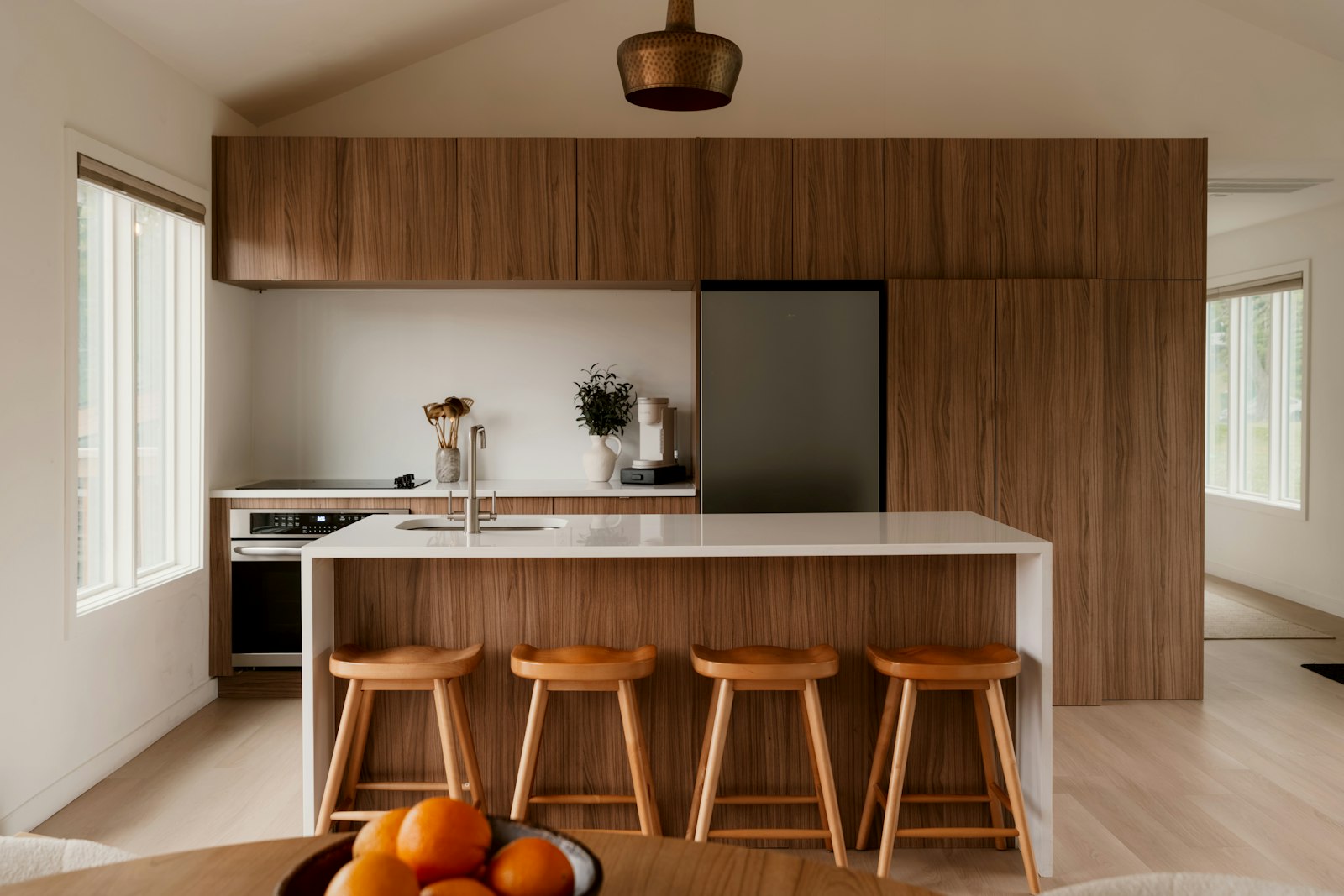
You sit on the sofa with a book, and the beautiful pendant light you spent months choosing hangs somewhere over the middle of the room, over nothing at all. Now imagine the same evening with the light falling exactly on the page, the table glowing softly behind you, and the corners of the room warm instead of grey.
Picture a couple who have moved into an Altbau apartment (the pre-1945 Viennese apartment building) in the Josefstadt. The living room has a single ceiling outlet, in the middle. Since moving in, a large pendant light has hung there, long sought and well chosen. In the evening the two sit on the sofa against the wall and read in the half-dark. Whoever stands up looks straight into the shade. In choosing designer luminaires, the two got everything right as far as the design is concerned. Only the question of what the fixture should do in this place was asked by nobody.
Contents
- Choosing designer luminaires begins with the task
- The three layers every luminaire belongs to
- Furniture first, then the light point
- What the shade does to the light
- Colour temperature, colour rendering and dimming
- What to clarify before buying
- What the costs depend on
- Frequently asked questions
- What happens next
Choosing designer luminaires begins with the task
A luminaire is first of all a tool that brings light to a particular place. Only then is it an object in the room. Anyone who reverses the order buys a handsome piece and wonders on the first evening why the room still is not right.
That is why at the start we do not ask which luminaire you like. We ask what you do here when it gets dark. Do you read, do you dine for a long time, do you work on a laptop, or do you merely walk through? The answers show where light is needed, how much of it and how it should fall. In this way the guiding question "How would you like to live?" is translated into concrete points of light.
For the couple in the Josefstadt this means: reading on the sofa in the evening, long dinners with friends at the weekend, the quick way from the hallway to the kitchen during the week. These are three situations with three different requirements. A single luminaire cannot fulfil them at once, however well it is designed.
A good luminaire in the wrong place remains a poor lighting solution.
Living with the wrong light costs more than it seems. Your eyes tire earlier, the evenings feel less cosy than the room deserves, and the fixture you paid so much attention to never shows what it can do. So how is light organised?
The three layers every luminaire belongs to
A lighting plan works with layers. In the living area we distinguish three, which the article on lighting design for the apartment explains in detail. Every luminaire you choose should be clearly assignable to one of these layers.
| Layer | Task | Typical luminaires | What matters |
|---|---|---|---|
| Ambient light | orientation, even brightness | recessed spots, wall washers, indirect light | unobtrusive, even, easy to dim |
| Zone light | dining, reading, cooking, working | pendant, floor, reading and under-cabinet lights | right height, no glare, enough light on the surface |
| Accent and atmosphere | depth, mood, focal points | table lamps, object lighting, pools of light | calm brightness, good form even when switched off |
A designer luminaire usually plays to its strength on the second or third layer. Ambient light is often provided by solutions you hardly see. Added to that is what the room itself brings: how much light falls through the windows and how walls and floors reflect it is described in the article on daylight, windows, mirrors and colour. A bright room with south-facing windows needs different answers in the evening from a courtyard room that is already dark by the afternoon. Where, then, does the light point belong?
Furniture first, then the light point
The most important rule is simple: a pendant light hangs over something. Over a table, an island, an armchair. That is why we fix light points only once the furnishing is in place. How big the sofa will be and where it finds its place affects everything else, so the topic of sofa and proportion in the living room is worth a look.
In the example the solution might look like this: the sofa moves away from the wall and stands freely in the room. The view no longer goes to the television but to the window, a thought developed further in the article on the living room without a TV wall. Beside the sofa stands a reading light, the large pendant moves over the dining table, and two wall lights provide the calm light at the edges.
If a light point is moved, the electrician has to come. In an Altbau this is often simpler when work on the ceiling or wall is due anyway. With stucco ceilings and old timber ceilings, we first check where an outlet and a fixing can sensibly be placed. Anyone who does not want to chase channels can work with an offset canopy and a neatly routed cable. In tall rooms that looks good but remains second choice to a properly placed outlet.
Pendant light over the dining table
Height, width and glare decide here. As a guide, the lower edge of a pendant light hangs about 60 to 75 centimetres above the tabletop, so that people can see each other beneath it. The luminaire should stay clearly narrower than the table, so that nobody bumps into the shade when standing up. With long tables, two or three smaller luminaires often work better than one large one. More on this is in the article on the dining table as the centrepiece.
Over the cooking island
In the kitchen the pendant light has a double task: it gives the island a centre and forms the transition to the living area. For chopping and cooking it is seldom enough on its own; that needs directed task light. How the layers complement each other is shown in the article on kitchen lighting in three layers. Anyone planning a new kitchen anyway is best advised to fix the light together with the fitted kitchens, because a hob with integrated extraction leaves the space above the island free.
Beside the sofa and reading chair
Reading light comes from the side or diagonally from behind, so that no shadow falls on the page. The shade should hide the light source from the seated position. A wall light with a swivel arm saves space, while a floor lamp stays movable. Picture a deep armchair by the window, a warm pool of light on the open book, and the rest of the room in soft shadow. How this comes together in a whole room is described in the article on the library and reading room at home.
What the shade does to the light
Two luminaires can give off the same amount of light and make a room look completely different. That is because of where they direct the light. When choosing luminaires it is therefore worth looking at the shade, not only at the outline.
- Opaque shade: The light falls downwards in a focused way. The table becomes bright, the room stays calmer and darker.
- Translucent shade of opal glass or fabric: The luminaire gives off soft light in all directions and brightens its surroundings too.
- Upward-directed light: The ceiling becomes a reflecting surface. That feels generous, but it calls for a light ceiling and enough room height.
- Visible light source: It can look lovely but quickly dazzles. Dimmed and outside the line of sight it works best.
Glare is easy to check but often forgotten. Look at the luminaire both seated and standing, because in the showroom it rarely hangs at the height it will have at your home. Look out also for reflections in glossy tabletops, glass doors and pictures. In open plans another task arises, since a well-placed luminaire can separate zones from one another, as the article on light as a room transition shows. And which numbers go with the light?
Colour temperature, colour rendering and dimming
Colour temperature is given in kelvin. Warm white light of around 2,700 kelvin suits the evening well in most living spaces, while 3,000 kelvin looks somewhat clearer. Within one room, avoid mixing markedly different values if you can; it is noticed immediately on the wall in the evening.
Colour rendering describes how natural colours appear under a light. It is given as an Ra or CRI value, and for living spaces we recommend a value of 90 or higher. Wood, fabrics, food and skin then look the way they should.
Dimming is not an extra but the difference between a bright meal and a long evening. Not every LED luminaire is dimmable, and not every dimmable luminaire is compatible with every dimmer. Flicker or humming are typical signs that the combination does not match. If you want to control several luminaires together, the article on smart home, sensible and invisible offers a calm approach.
What to clarify before buying
We use this list before a luminaire is ordered. It fits on a slip of paper and spares you many disappointments.
- Task: Which layer does the luminaire belong to, and for which situation is it there?
- Position: Is the furnishing settled, and does the outlet fit it?
- Dimensions: Do diameter, height and suspension suit the furniture and the room height?
- Light: Are luminous flux in lumens, colour temperature, colour rendering and beam direction right?
- Control: Is the luminaire dimmable, and does it suit the existing dimmer or system?
- Light source: Can it be replaced, or is it permanently built in, and what happens in case of a fault?
- Fixing: Does the ceiling construction carry the weight, and what fixing does it need?
- Care: How do you clean the shade, and does it collect dust, or grease in the kitchen?
Points two and five are tied directly to the electrics. Both should be settled before walls are closed, as the article on electrical planning explains. A floor lamp wished for afterwards with no socket nearby otherwise means a cable across the room.
What the costs depend on
What lighting costs is decided less by a single luminaire than by the overall solution. What counts is how many light points the room needs, whether outlets have to be moved and whether ceilings or walls must be opened for that. The control system also plays a part, as do the design, material and size of the visible luminaires.
It makes sense to distribute spending by effect. You see the luminaire over the dining table every day, and it may be a special piece. The recessed spot in the hallway above all has to be reliable. What good workmanship looks like in luminaires too is described in the article on quality in Italian design. We talk openly about the budget from the first conversation, and with us one contact person leads the work from the first sketch to the handover, supported by Tischlerkultur, our joinery workshop in the Viennese carpentry tradition of 1935.
Lighting rarely becomes too expensive because the luminaire is too beautiful. It becomes expensive when you notice after painting that the outlet is in the wrong place.
Frequently asked questions
How high should a pendant light hang over the dining table?
As a guide, the lower edge hangs about 60 to 75 centimetres above the tabletop. That keeps the view of the people opposite clear, and the light falls on the table rather than into the eyes. The size of the luminaire, the room height and the shade shape can shift the value, so a test before the final installation is worthwhile.
Is one large ceiling light enough for the living room?
Usually not, because a single luminaire rarely fulfils all tasks. It can brighten the room but can hardly supply good reading light and evening mood at the same time. Several smaller light sources at different heights feel more homely and can be adapted better to the situation.
Which colour temperature suits the living room?
Warm white light of around 2,700 kelvin is a good choice for the evening in most living spaces, while 3,000 kelvin looks somewhat clearer. What matters is that the luminaires in a room suit one another. Look also for good colour rendering, so that wood, fabrics and skin look natural.
How many luminaires does a living space need?
There is no fixed number, because it follows from the use and the size of the room. It makes sense to supply every activity and every zone with a suitable light source and to provide calm ambient light in addition. A floor plan with the planned furnishing quickly shows where light is missing.
Can a designer luminaire be installed in an Altbau without chasing channels?
Often yes, for instance with an offset canopy, a floor lamp or a wall light with a visibly routed cable. The fixing must, however, suit the weight of the luminaire and the ceiling construction, which should be checked in advance, especially with old ceilings. A properly placed outlet remains the cleanest solution if work is being done anyway.
Are luminaires with a built-in LED a disadvantage?
Not necessarily, because built-in LEDs allow very slim forms and last long when well made. Before buying, ask whether the module and the driver can be replaced in case of a fault. For a luminaire that is meant to stay for many years, this is one of the most important questions. We check it with you before anything is ordered.