Bath & Wellness · 9 min read
Bathroom Taps: Chrome, Brass or Stainless Steel? What Stays Beautiful
It is the seventh winter, and the lever under your hand still glides as softly as on the first day. The brass still glows warm, the jet falls into the middle of the basin, and nothing has flaked or turned dull. That is the tap you choose today, if you choose it for the right reasons.
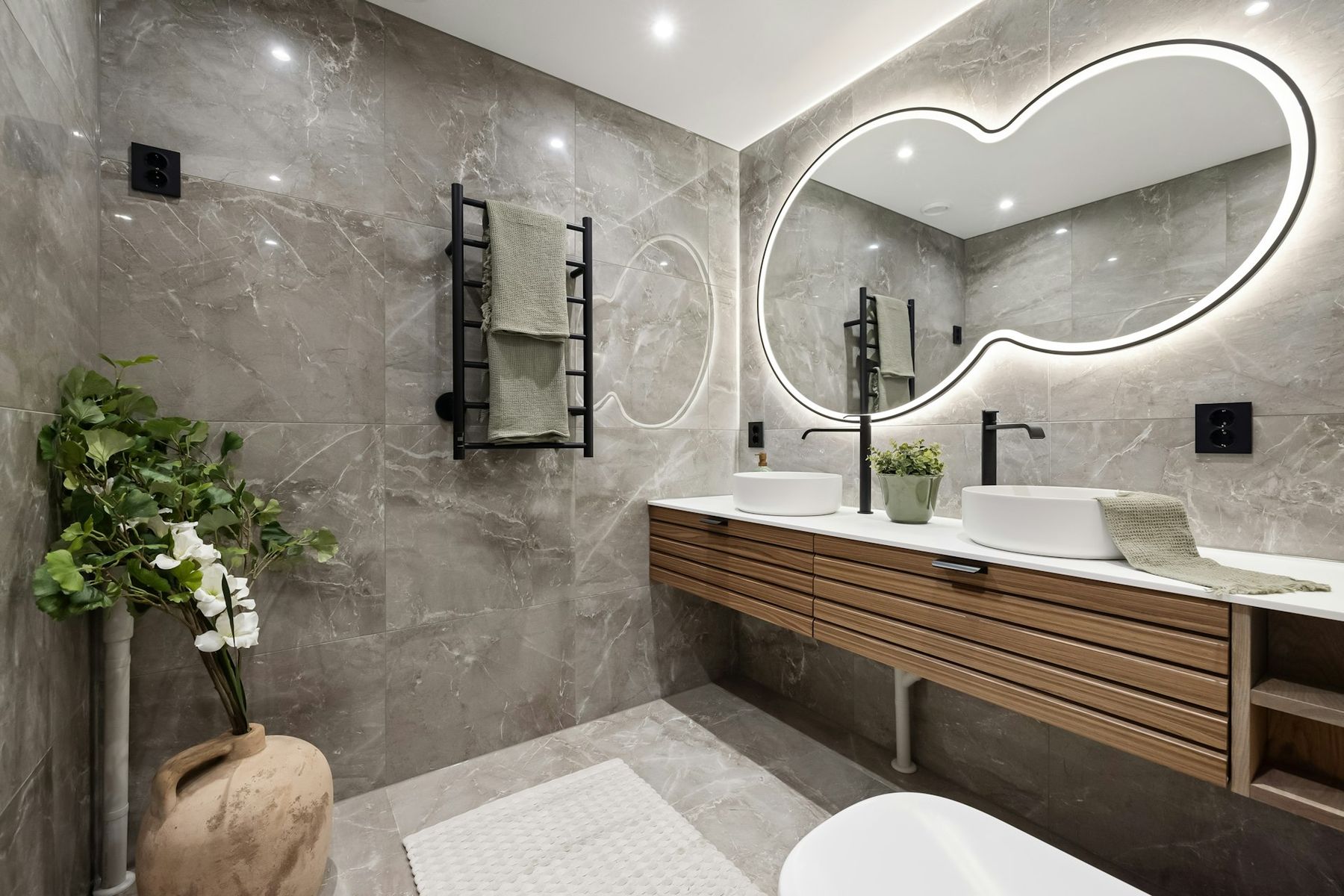
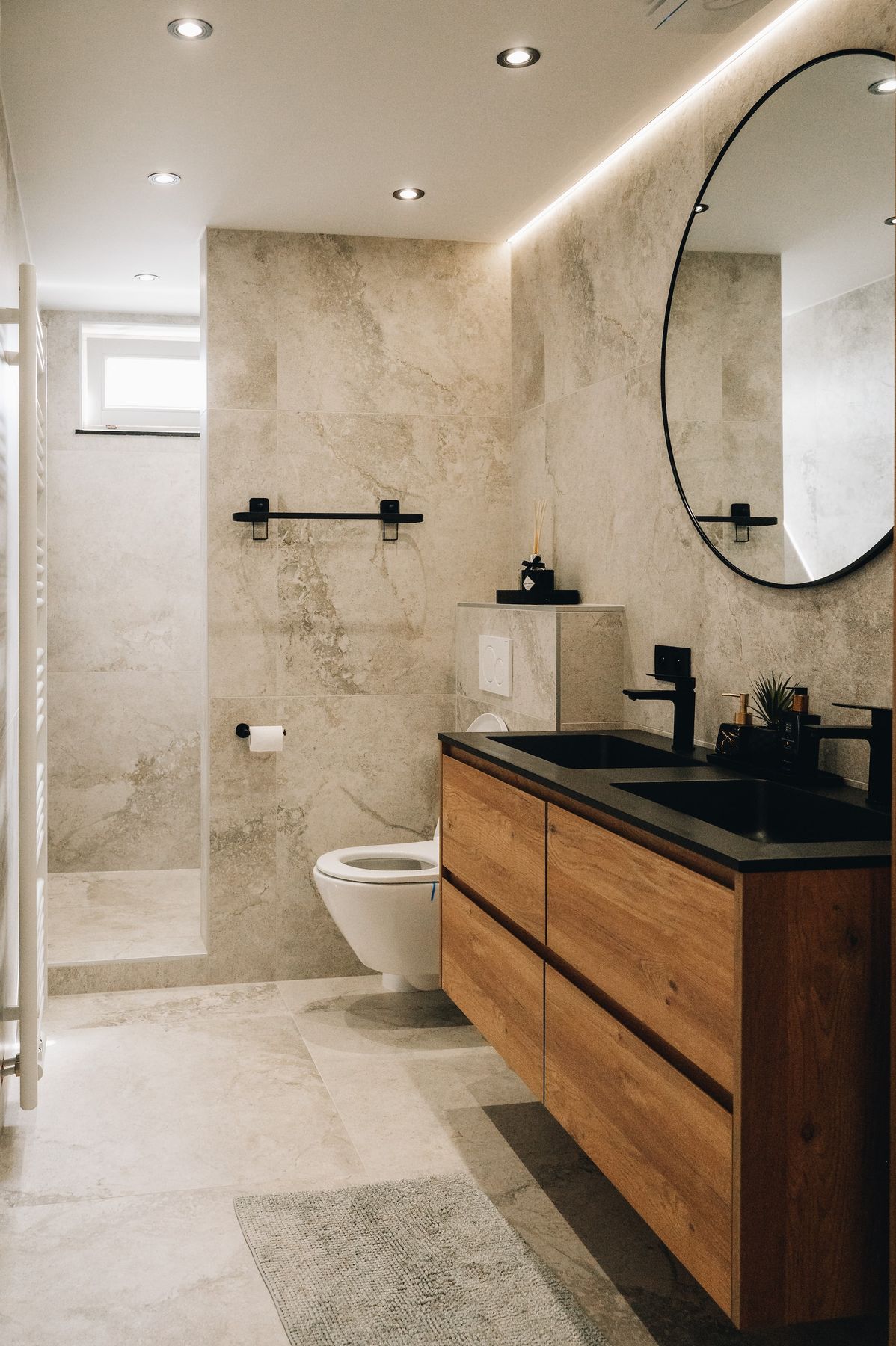
Picture a couple in an apartment in the Josefstadt, Vienna's 8th district. The new bathroom is almost fully planned: pale stone, an oak washstand, a walk-in shower. Only one question remains open, and it has occupied the two of them for weeks. She would like brushed brass, warm and soft. He wonders whether in ten years it will not look like the gold taps of the 1980s. Both have a point, and the answer lies deeper than colour.
Contents
- Why the tap matters more than it looks
- Comparing the finishes
- Limescale in Vienna: what the water does to the finish
- The technology in the wall: planning concealed fittings properly
- Thermostat and shower: comfort you feel every day
- One metal for the whole bathroom: the common thread
- How to recognise high-quality bathroom taps
- Frequently asked questions
- What happens next
Why the tap matters more than it looks
A tap is the part of the bathroom you touch most often. Several times a day, for years. You feel how stiff the lever is, whether the water reaches the right temperature at once, and whether the jet falls quietly or splashily into the basin. At the same time it is one of the few elements that cannot simply be swapped once it sits inside the wall.
That is why close scrutiny pays off more with taps than with almost any other fixture. A good tap has a body of brass or stainless steel, a precise ceramic cartridge and a finish that does not flake after a few years. And it comes from a manufacturer that will still supply spare parts in ten years.
A tap is not judged by how it looks in the showroom, but by how it feels in the seventh winter.
The hidden bill of a wrong choice. Choose by showroom shine and you may live for years with a lever that sticks, a finish that dulls or a spout that splashes. And because the technology sits in the wall, a wrong choice is rarely a swap. It is a job for the tiler. So what do the finishes really do?
Comparing the finishes
The finish determines appearance, care and ageing. We meet these variants in almost every bathroom plan:
| Finish | Appearance | Care | Ageing |
|---|---|---|---|
| Chrome (electroplated) | cool, clear, timeless | very easy, limescale visible | very stable, scratches rare |
| Brushed brass (PVD) | warm, soft, homely | easy, limescale less visible | very hard, scratches cannot be repaired |
| Solid stainless steel, brushed | calm, technical, matt | easy, few fingerprints | hardly any wear, can be re-ground |
| Matt black | graphic, striking | demanding, limescale clearly visible | varies by process |
| Untreated brass | lively, patinated | consciously accepting the patina | changes constantly |
Chrome: the underestimated classic
Chrome is the most widespread finish, and for good reasons. Electroplated chrome is hard, smooth and easy to clean. It does show water spots, but a soft cloth makes it clean again in seconds. Chrome does not look fashionable but neutral, and suits almost any material. If you are planning a bathroom for twenty years, you will rarely go wrong with chrome.
Brushed brass: warm, but mind the technology
The term "brushed brass" usually describes not bare brass but a colour tone. The tap has a brass body and a PVD coating in a brass look. PVD stands for Physical Vapour Deposition, a process in which a very thin, very hard layer is applied in a vacuum. These finishes are considerably more resistant than classic lacquers.
One drawback: a deep scratch in a PVD layer can hardly be repaired. And shades differ between manufacturers, sometimes even between ranges. If you combine basin tap, shower head, shower channel and towel rail from different makers, you will see it. That is why, with brass tones, we choose all the elements from one range wherever possible.
Stainless steel: robust and honest
Taps made of solid stainless steel have no coating that can wear off. The surface is the material itself. Fine scratches on brushed stainless steel can often be worked out again. Stainless steel looks calmer and more technical than brass and goes well with concrete, ceramic and pale timber. It is usually dearer than comparable chrome taps, but extremely long-lasting. Finish is one half of the story. The other half comes out of the tap: the water.
Limescale in Vienna: what the water does to the finish
Vienna's tap water comes largely from alpine spring sources and is, depending on the district, mostly soft to moderately hard. In some municipalities in Lower Austria the water is considerably harder. You can find out the exact hardness from your local water supplier. For taps this means: limescale spots appear everywhere, but at different speeds.
Water spots show most clearly on gleaming chrome and matt black. Brushed finishes in brass or stainless steel are more forgiving. More important than the finish, however, is care: many finishes tolerate neither abrasives nor acidic descalers. A soft cloth after showering and a mild cleaner are usually enough. You should know the manufacturers' care instructions before buying, not after the first stain.
One detail with a big effect: flow regulators with an anti-limescale function, where limescale rubs off easily. How surfaces in the bathroom behave over the years in general is described in Easy to care for? Which surfaces still look good after five years. And what you cannot see decides how long all of this lasts.
The technology in the wall: planning concealed fittings properly
Many high-quality bathroom taps are concealed fittings. You see only the lever and spout, while the technology sits in a rough-in body in the wall. This looks calm but demands an early decision. The rough-in body is installed long before the tiles arrive.
These points must be settled for this:
- Range and manufacturer: the rough-in body fits only the finish sets of the same system family.
- Function: single-lever mixer or thermostat, one or several outlets, diverter for overhead and hand shower.
- Position and height: height above the washstand, distance from the wall, position in the shower, alignment with the tile joint.
- Reach of the spout: the water jet must hit the middle of the basin, not the edge.
- Wall build-up: the installation depth depends on the false wall, plaster and tile thickness.
A wrongly chosen spout is one of the commonest mistakes in bathrooms. It is too short, and the water runs along the basin edge. Or it is too high, and it splashes every time you wash your hands. This coordination belongs to the planning of the washstand, which we describe in Made-to-measure washstands.
The most beautiful tap is worthless if its jet lands three centimetres off the centre of the basin.
Exposed or concealed?
Not every bathroom needs concealed fittings. An exposed tap sits visibly on the wall or on the washstand, and the technology is inside the tap body itself. It is simpler to install, easier to service and quickly swapped when it is renewed later. For bathrooms with little wall depth, for rented apartments or for a washstand on which the tap is deliberately meant to stand as an object, it is often the better choice.
Concealed fittings, by contrast, look calmer, because you see only lever and spout. Surfaces stay clear and are easier to clean. The price is an early commitment and servicing that goes through the finish set. High-quality systems are built so that cartridges and thermostat inserts can be exchanged from the front, without opening the tile. This is exactly what you should check with the manufacturer before deciding. Whichever you choose, comfort in the shower follows from one more decision.
Thermostat and shower: comfort you feel every day
In the shower we almost always recommend a thermostat. It holds the set temperature even when someone else in the apartment draws water at the same time. In everyday life this makes a big difference, especially in an Altbau (the pre-1945 Viennese period building) with older pipework and in the morning when two people are in the bathroom together. Scald protection is also sensible, above all with children or older people in the household.
The overhead shower is often overrated, the hand shower underrated. For daily showering, rinsing the shower down and washing hair, many people use the hand shower more often. It should sit well in the hand and rest in a holder that is easy to reach. How the shower works as a whole is covered in Planning a walk-in shower. Last, one finish ties everything in the bathroom together.
One metal for the whole bathroom: the common thread
A calm bathroom comes about when all the visible metals go together: taps, showers, drain covers, shower channel, towel rails, mirror frames, door handles, light fittings. Two different metal tones can work deliberately. Five different ones look accidental.
In our example, the decision becomes clear. Brushed PVD brass for basin tap, thermostat, hand shower and shower channel, all from one range. The towel rails in the same finish, the lights with a brass-coloured detail. In the guest WC, by contrast, deliberately chrome, because a dark stone sets the tone there. This creates calm in the large bathroom and a character of its own in the small one. Imagine stepping into the bathroom at six in the evening: the brass glows softly against the pale stone, and every metal belongs to the same family. You will find more ideas for the guest WC in Designing a guest cloakroom.
This thought reaches beyond the bathroom. When the kitchen tap, the handles of the fitted cupboards and the door levers follow one line, a continuous picture emerges. How to develop a materials concept for it is explained in The materials concept: the common thread. Similar rules apply to the kitchen, which we take into account with our fitted kitchens. The same hands are behind both: our own joinery Tischlerkultur, in the Viennese tradition since 1935, and one person who keeps the whole bathroom in view.
How to recognise high-quality bathroom taps
You cannot recognise high-quality bathroom taps by price alone. These features help in assessing them:
- The body is made of brass or stainless steel, not die-cast zinc or plastic.
- The cartridge is a ceramic cartridge with an even, light action.
- The lever moves without play and does not click into place stiffly.
- The manufacturer states long availability of spare parts.
- The finish is electroplated chrome, PVD-coated or solid stainless steel.
- The tap carries the test marks customary in Austria for the drinking water sector.
- The system offers rough-in bodies and finish sets from one family that fit together.
Italian tap design is often expressive and serves as a design reference. In each project we choose the range that suits the bathroom, budget and use. What matters to us is less the name than the question of whether a cartridge, a flow regulator or a handle can still be supplied in ten years. A tap that has to be replaced because of one small spare part is neither sustainable nor cheap. Which costs arise across the whole bathroom is shown in What does a bathroom renovation cost in Vienna?.
Frequently asked questions
Which tap finish is the easiest to maintain?
Brushed finishes in stainless steel or PVD-coated brass show water spots and fingerprints the least. Chrome is also very easy to maintain but shows limescale more clearly. Matt black is the most demanding, because limescale is particularly visible on it. Test the finish on a sample in your own light.
Is brushed brass just a trend?
Warm metal tones are popular at present, but high-quality brushed brass with a PVD coating is robust and looks considerably calmer than the glossy gold tones of earlier decades. Whether you will still like it in ten years depends above all on whether it suits the materials of the bathroom. With pale stone, timber and calm surfaces it usually ages well. A sample in your own bathroom shows it honestly.
What does PVD mean for taps?
PVD stands for Physical Vapour Deposition. A very thin, very hard layer is applied to the tap in a vacuum. PVD finishes are considerably more resistant than lacquers, but deep scratches can hardly be repaired.
Are stainless steel taps better than chrome-plated ones?
Solid stainless steel taps have no coating that can wear off and are therefore very long-lasting. Chrome-plated brass taps of good quality are also very durable, however. The difference lies more in appearance and price than in durability.
When do you have to choose the taps for the bathroom?
With concealed fittings the range must be settled before installation begins, because the rough-in body goes into the wall early. Position, height and function are fixed at this stage. The visible finish sets are fitted only after tiling. In the first call we tell you exactly when.
How do you clean high-quality taps properly?
With a soft cloth, water and a mild cleaner. Abrasives, coarse-textured microfibre sponges and acidic descalers can damage many finishes. Wiping dry briefly after showering prevents most limescale spots.