Bath & Wellness · 9 min read
How Long Does a Bathroom Renovation Take? A Realistic Timeline, Week by Week
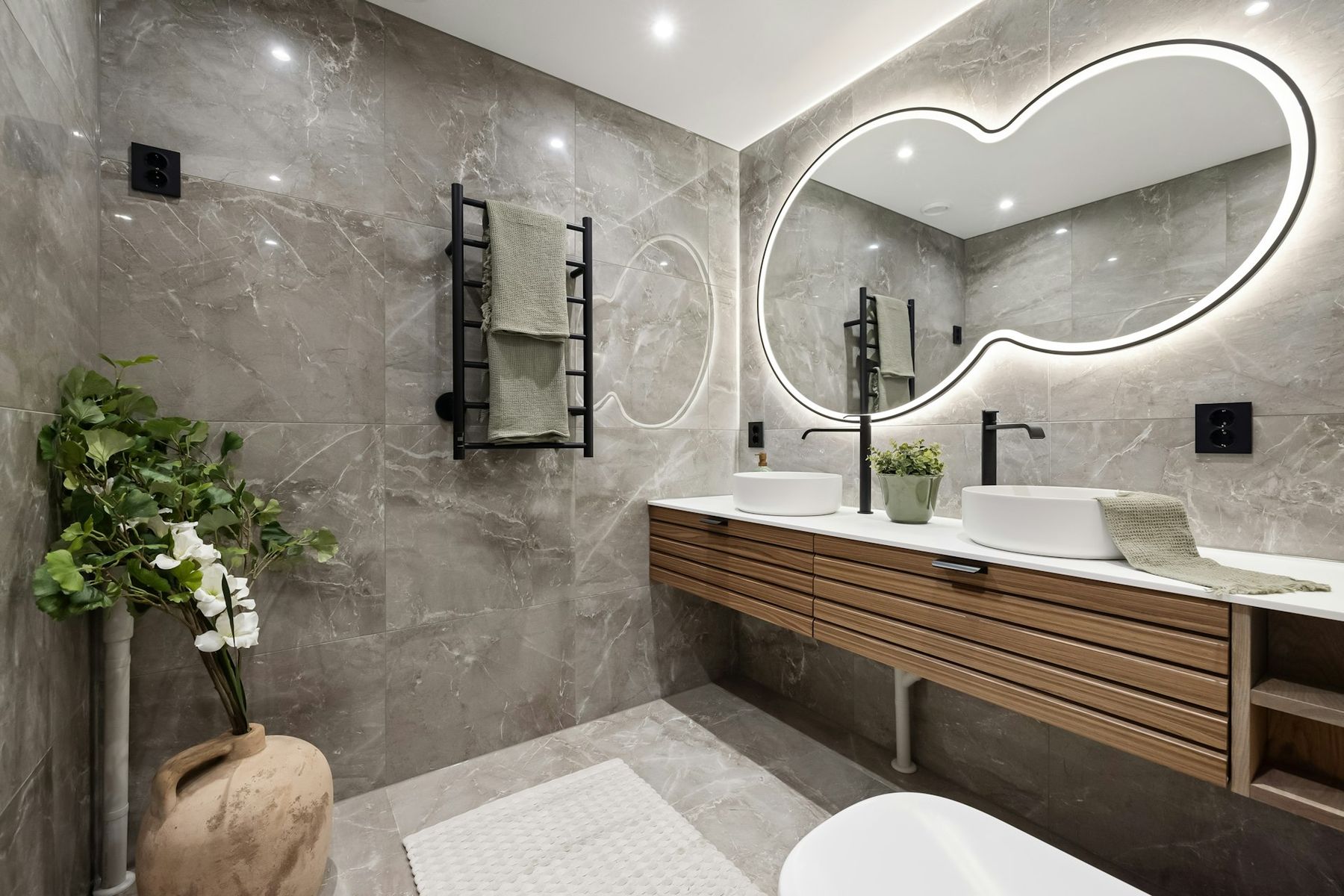
It is a Monday morning, the queue for the one bathroom has formed again, and you ask yourself the question you have asked for years: how long would we be without it? Now picture the other end of the timeline: a quiet Saturday morning, a rain shower running, the grout still smelling faintly of new work.
Let us call them the K. family: two adults, two school-age children, an apartment in Floridsdorf with exactly one bathroom. The bath is old, the grout is dark, and the wish for a new shower has existed for years. What has held the two of them back so far is not the money but a single question: "How long will we be without a bathroom?" That question deserves an honest answer, and it consists of more than one number.
Contents
- A bathroom renovation in four phases
- Planning: why the first weeks shorten the building time
- Lead times: the invisible part of the schedule
- The building phase step by step
- What delays a bathroom renovation
- How to shorten the duration of a bathroom renovation
- Living through a bathroom renovation
- Time and cost are connected
- Frequently asked questions
- What happens next
A bathroom renovation in four phases
Anyone asking how long a bathroom renovation takes usually means the time during which the bathroom cannot be used. But this building phase is only one part. A bathroom renovation consists of four phases, and the first three decide how short and calm the fourth will be.
| Phase | Content | Typical duration |
|---|---|---|
| 1. Initial consultation and survey | Wishes, measurements, photographs, technical check | 1 to 2 weeks |
| 2. Planning and decisions | Layout, materials, fixtures, lighting, quotation | 3 to 6 weeks |
| 3. Ordering and lead times | Ceramics, taps, furniture, bespoke pieces | 4 to 10 weeks |
| 4. Execution | Demolition to handover | 3 to 8 weeks |
The phases overlap. While the furniture is being made, the site can be prepared. The overall duration is therefore shorter than the sum of the rows. What matters is only this: demolition should begin only when all the important parts have been ordered and delivery dates confirmed.
A bathroom is finished quickly when demolition starts only once everything has been decided.
So what happens in those first weeks, when nothing seems to be happening?
Planning: why the first weeks shorten the building time
In the planning phase the layout emerges, the positions of shower, washstand and WC, the materials and lighting concept. Technical clarification follows: where is the stack, how much build-up height does the floor have, what ventilation is possible? In an Altbau, trial openings are part of it. What to bear in mind is described in Bathrooms in the Viennese Altbau.
In this phase most of the time is taken up not by us but by decisions. Which tile, which tap, which washstand? Many people want to see samples, touch them, discuss them with their partner. That is as it should be. Every decision made now is a decision that holds nobody up on site later. How you can prepare for the first conversation is covered in Preparing for the initial consultation. Then comes the part of the schedule you cannot hurry.
Lead times: the invisible part of the schedule
Lead times are the part that is easiest to underestimate. They depend on the product, the manufacturer and sometimes the season. As a guide:
- Ceramics and tiles: two to eight weeks, large-format or rare surfaces tending to take longer.
- Taps: two to six weeks, special finishes such as brushed brass often longer.
- Sanitary ceramics: two to six weeks, depending on the range.
- Washstand and made-to-measure furniture: six to ten weeks, depending on material and workshop capacity.
- Glass shower screen: two to three weeks from measuring, which usually takes place only after tiling.
The last point surprises many people. A glass shower screen is made to the millimetre and is therefore measured only once the tiles are laid. That means the bathroom is finished, but the shower has no glass yet. During this time you can often already shower, if with care. We plan this gap in from the start instead of explaining it at the end.
Because our own joinery, Tischlerkultur, makes the washstand, furniture production runs in parallel with the building work. The workshop carries on a Viennese carpentry tradition begun in 1935. How a made-to-measure washstand fits into the sequence is explained in Made-to-measure washstands. And once everything is ordered, the site finally comes to life.
The building phase step by step
Execution follows a fixed sequence. Each step builds on the previous one, and some steps need drying time in which nothing visible happens. For a bathroom of roughly 6 to 8 square metres, a typical sequence looks like this:
- Protection and demolition (2 to 4 days): cover routes, remove old tiles, bath and pipes, haul away rubble.
- First fix (3 to 5 days): new water and waste pipes, false walls, concealed bodies, electrical cables.
- Screed and plaster (2 to 3 days, then drying): new floor build-up with fall, levelling the walls.
- Drying (a few days to several weeks): depending on screed type and thickness.
- Waterproofing (1 to 2 days): across the full surface in the wet area, with sealing tapes at all junctions.
- Tiles and surfaces (5 to 10 days): depending on format, area and level of detail.
- Fitting (2 to 4 days): WC, washstand, taps, lights, mirror, accessories.
- Glass and completion (1 to 2 days after delivery): shower screen, silicone joints, final clean, handover.
Drying times: the pause you should not shorten
A classic cement screed needs time before it may be waterproofed and tiled. As a rough rule of thumb, allow about one week per centimetre for thin layers, and longer for thicker ones. Whether the screed is ready is decided not by the calendar but by a moisture measurement. Rapid-setting screeds cut this time considerably to a few days and are often sensible in bathrooms.
Anyone who shortens the drying risks cracks, loose tiles and waterproofing that does not hold. This is the wrong place to save time. You can read more about waterproofing and fall in the shower in Planning a walk-in shower.
The days on which apparently nothing happens on site are often the most important ones for a bathroom that lasts twenty years.
What delays a bathroom renovation
Most delays are foreseeable. They cannot always be avoided, but they can almost always be allowed for.
- Late decisions: the tap has not been chosen yet, but the plumber needs the concealed body.
- Delivery delays: a product arrives later, or a batch is damaged.
- Surprises in the existing building: rotten beams, a narrowed stack, old pipes that have to be renewed as well.
- Consents: the Hausverwaltung (the building's property management) needs time, or the stack may only be shut off on certain days.
- Changes during the building phase: one more niche, the shower ten centimetres wider, a different tile.
- Holidays and public holidays: around Christmas and in summer, suppliers and tradespeople work to a limited extent.
For Altbauten, permits and consents are added, which we explain in Conversions in the Viennese Altbau: permits. It is worth asking early here.
Why a buffer is not distrust
An honest schedule contains a buffer. For a bathroom renovation we generally allow a few days of reserve, and more in an Altbau. This has nothing to do with a lack of trust in the tradespeople, but with experience. Something almost always turns up: a pipe behind the tile that nobody expected, a delivery that arrives two days later, a screed that takes longer in a damp autumn.
A buffer has a big advantage for you. If it is not needed, the bathroom is finished earlier, and that is good news. If it is needed, nothing shifts, and nobody has to re-plan the holiday, the move-in or the in-laws' visit. A schedule without a buffer sounds better in a quotation but creates pressure on site, and pressure is the natural enemy of careful waterproofing. So how do you make the whole thing shorter?
How to shorten the duration of a bathroom renovation
A bathroom renovation cannot be accelerated at will, but it can be tightened considerably. These levers have proved their worth:
- Decide everything before demolition begins. This is the most important point.
- Order early and have delivery dates confirmed in writing.
- Use rapid-setting screed where it is technically suitable.
- Time the trades closely, so that no day is left empty without breaking drying times.
- Have one point of contact who coordinates all the trades and bundles decisions.
The last point is the underestimated one. When plumber, electrician, tiler, joiner and glazier are commissioned separately, gaps arise between the appointments. When one person is responsible for the sequence, these gaps shrink. With us that person accompanies you from the first sketch to the handover. Why this changes so much for clients is described in Planning and execution from a single source.
Living through a bathroom renovation
Back to the K. family and their question. Three to five weeks without their own bathroom sounds long. With a little preparation, though, they can be bridged well.
In many cases the WC is out of action for only a few days and can then be reconnected temporarily until the false wall is finished. For showering, family, neighbours, a gym or, for a longer building phase, a short-term holiday flat are options. Some families move the date to a period when part of the family is away anyway. Anyone with two bathrooms renovates one after the other.
For the K. family, a plan in three steps emerged: all decisions were made in spring, the orders went out in April, and demolition began on the first day of the school holidays in July. The WC was usable again temporarily after four days, and showering was done at the grandparents' a few streets away. After four weeks there was the first shower in the new bathroom, and two weeks later the glass arrived. Is it cheaper to wait?
Time and cost are connected
A shorter building time is not automatically dearer, whereas a chaotic one almost always is. Every additional day on site ties up tradespeople, and every change during execution causes waiting time and extra cost.
Waiting costs something too. Every month with the old bathroom is a month of queues, of grout you stopped seeing and of a nagging question about what may be hiding behind the tiles. The actual costs of a renovation depend on the project, and we talk about them openly from the first conversation. Which items typically arise is shown in What does a bathroom renovation cost in Vienna?. Anyone renovating the whole apartment will find the larger timeframe in The realistic timeline of an apartment renovation. How we plan and carry out bathrooms can be seen on our page on bathroom renovation.
Frequently asked questions
How long does a bathroom renovation take on average?
The building time alone for an average bathroom is usually between three and five weeks. For Altbauten or elaborate bathrooms it can be five to eight weeks. From the first idea to completion, with planning and lead times, three to five months generally pass. We tell you what to expect for your project in the first conversation.
How long are you without a bathroom during the renovation?
You are usually without a working shower for the duration of the building phase, that is three to five weeks. The WC can often be reconnected temporarily after a few days. Anyone with two bathrooms renovates them one after the other.
Why does the glass shower screen take so long?
A glass shower screen is made to the millimetre and is therefore measured only after tiling. Production then usually takes two to three weeks. During this time the bathroom is already usable, but the shower still has no glass. We plan this gap in from the start.
How long does the screed in the bathroom have to dry?
That depends on the type and thickness of the screed. As a rough rule of thumb, classic cement screed needs about one week per centimetre at thin layers; rapid-setting screeds are ready for covering within a few days. A moisture measurement before waterproofing and tiling is decisive.
Can a bathroom renovation be speeded up?
Yes, above all through early decisions and orders before demolition. Rapid-setting screed and close timing of the trades shorten the building phase further. One point of contact who coordinates all the trades prevents idle time between appointments.
When is the best time for a bathroom renovation?
There is no single best time. A sensible building phase is one in which the family is flexible, for example during a trip. Planning should begin three to four months beforehand, so that all decisions and deliveries are ready in time. Call us, and we will count back from your date.