Kitchen · 11 min read
Hob with Integrated Extractor: Cook in the Middle of the Room, Not Under a Hood
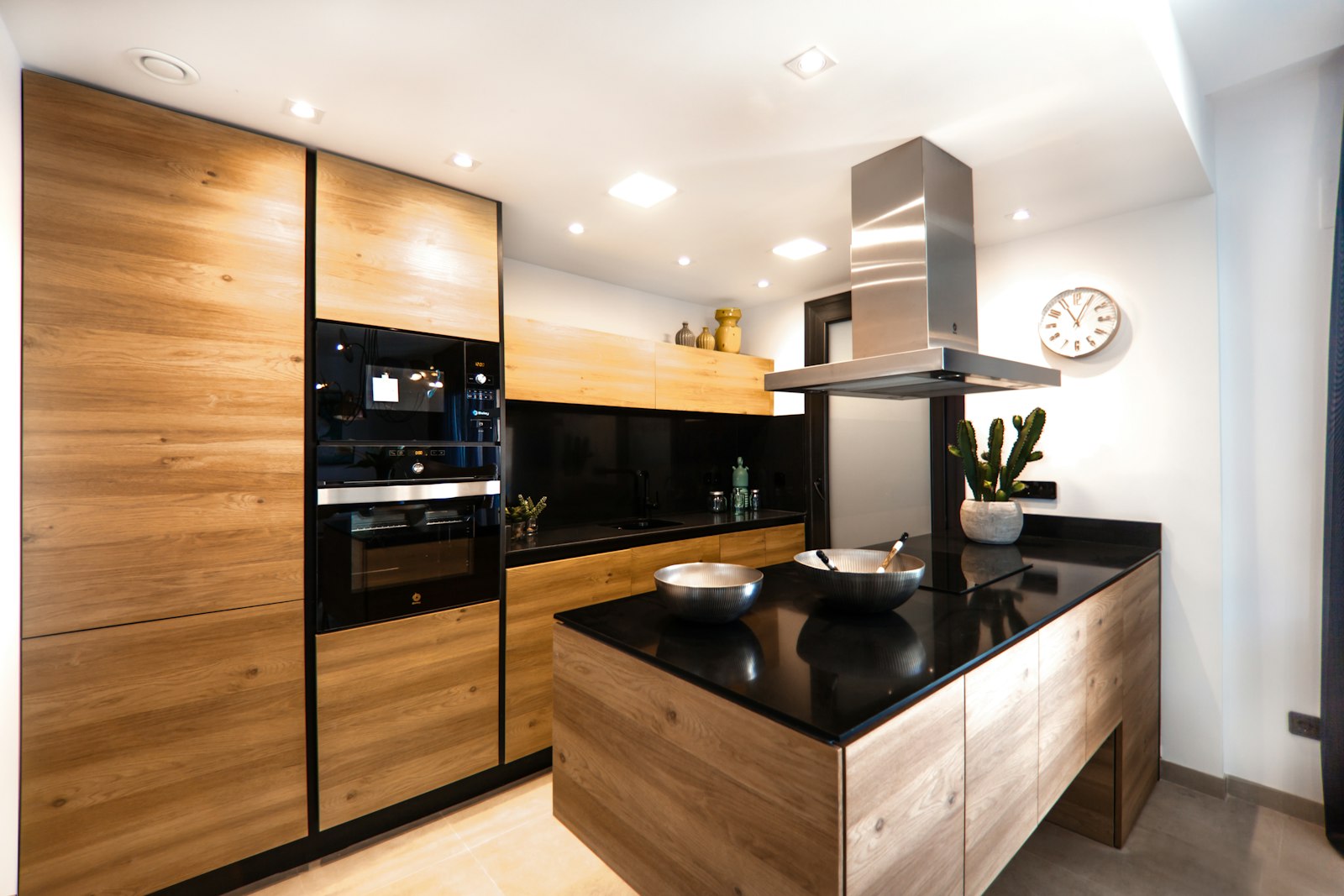
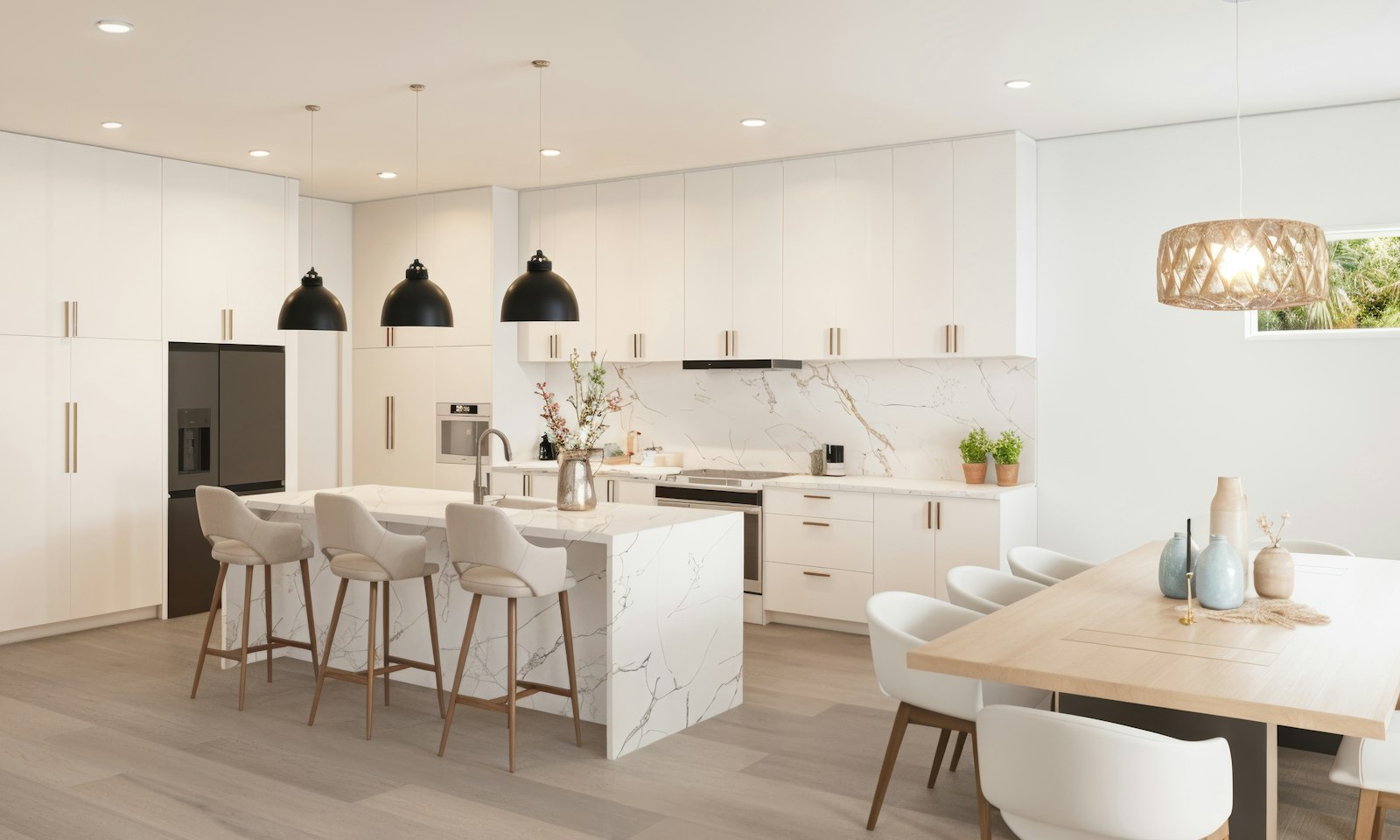
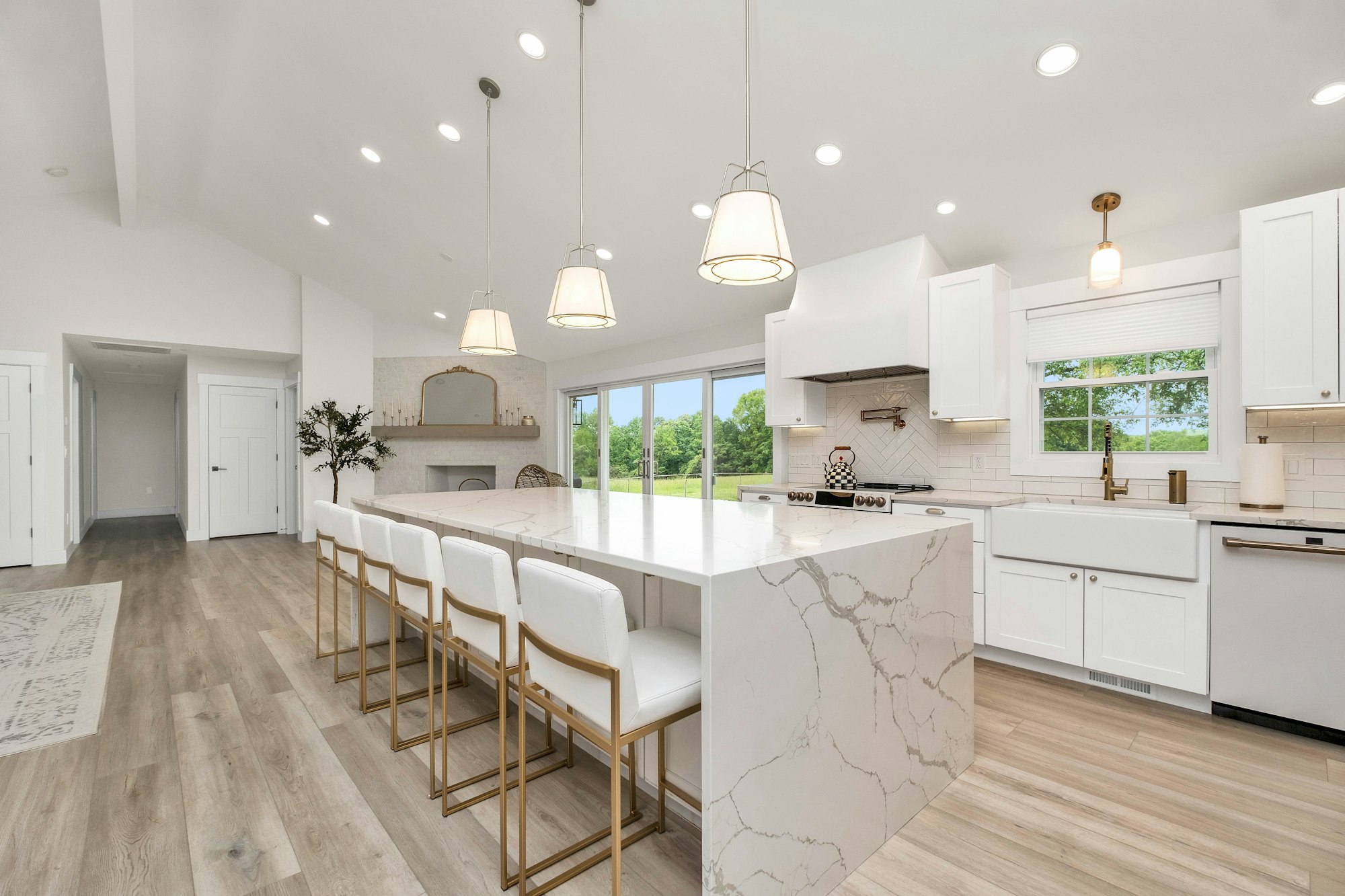
You stand at the hob, talking to your guests, and a steel hood hangs between you and them. Now imagine the same moment with nothing above you: pendants low over the island, the tall windows in view, steam drawn away at the pan. Picture a couple in an Altbau flat (a pre-1945 Viennese apartment building) in the fourth district. The wall between kitchen and living room has come down, and in its place stands a kitchen island facing the windows. At the first planning meeting, a question arrives that almost every open floor plan raises: where does the extractor hood go? A large island hood would block precisely the sightline for which the wall was opened. The downdraft extractor decides whether the room stays open.
Contents
- What a hob with an integrated extractor is
- Who benefits from a downdraft extractor
- Recirculating or ducted: the most important technical decision
- What the base unit has to deliver
- Everyday life: cleaning, noise and habit
- The downdraft extractor in the overall kitchen plan
- Costs: what to budget for
- Frequently asked questions
- What happens next
What a hob with an integrated extractor is
A hob with an integrated extractor is a hob, usually induction, with an intake opening in the middle or along its edge. A fan in the base unit pulls in the rising steam from the side before it spreads through the room. The principle rests on a simple observation: steam does not rise straight up like a column, and a sufficiently strong cross-flow just above the pan can divert it.
Manufacturers have developed this principle considerably in recent years. There are now systems in different widths, with flexible-zone induction, with teppanyaki plates and with modules that can be combined. The basic idea remains the same: the technology disappears beneath the worktop, and what remains on top is a calm, flat surface.
A hood hangs in the room. A downdraft extractor belongs to the worktop. That changes how an open kitchen feels.
For the design, this means the airspace above the island is free. Pendant lights can hang where they are right for the lighting, not where the hood leaves room for them. For more on planning the light over an island in layers, read our article on kitchen lighting on three levels. But who really benefits from a downdraft extractor?
Imagine it finished. The pendants hang low over the island, where the light is right. You cook in the middle of the room, guests opposite, the windows behind them, and the steam is gone before it reaches the room. No niche, no hood, just the worktop and the people around it.
Who benefits from a downdraft extractor
Not every kitchen needs a downdraft extractor. In a closed kitchen with a single run along the wall, a well-planned flat-screen hood or a model integrated into the wall units can work just as well and often costs less. The downdraft extractor plays to its strengths where the architecture demands it.
Typical situations in which we recommend it:
- Kitchen islands in open-plan kitchens, where a hood would disturb the sightline or the effect of the ceiling.
- Attic flats and penthouses with sloping ceilings, where a wall-mounted hood simply has no room.
- Kitchens in front of a window, for instance when the hob is to sit beneath an Altbau window.
- Altbau flats with high ceilings, where an island hood would have to be suspended on a very long drop and would still hang far above the cooking.
- Households that value conversation while cooking: anyone standing at the hob and talking to guests sees them without a hood in the way.
The system is less ideal for people who very often cook with tall pots, for example large quantities of soup or stock in vessels more than 25 centimetres high. Here the extractor has to capture the steam higher up, and although a stronger setting usually manages this, it does not come as naturally as with a frying pan. If you do a lot of wok cooking at high heat, raise it during the consultation and, if possible, see the system in operation beforehand.
Putting up with the wrong extraction has a quiet cost. A hood over an open island dominates the room you opened up, and you look at it every day. And the wrong choice of system is hard to change later, because it lives in the base unit, the floor and the wall. Once you know whether a downdraft system suits you, one technical decision remains: recirculating or ducted?
Recirculating or ducted: the most important technical decision
Every extractor, whether a hood or a downdraft system, works either with ducted extraction or with recirculation. This decision shapes the planning more than the choice of model.
| Criterion | Recirculating | Ducted |
|---|---|---|
| Principle | Air is filtered and returned to the room | Air is led outdoors |
| Odour removal | via activated carbon or special filters, regular replacement needed | very good, odours leave the building |
| Moisture | stays in the room, ventilating remains important | is carried away |
| Building work | minimal, no wall opening | duct and wall box required |
| Viennese multi-occupancy building | almost always feasible | often difficult, consent required |
| Energy in winter | warm air stays in the room | cold outside air flows in to replace it |
In Viennese Altbau flats, recirculation is the rule. A ducted extraction run through the façade generally needs the consent of the owners' association or the property management (Hausverwaltung), and with protected façades the building authority becomes involved as well. We have summarised which approvals are generally required for conversions in an Altbau in our article on permits for renovating a Viennese Altbau.
In a detached house in Lower Austria, the picture is different. There, ducted extraction is often perfectly feasible, with the duct running in the plinth or the floor to the outside wall. One peculiarity matters: if the house has a flue-dependent heating appliance, such as a wood-burning stove, a ducted extractor must not create dangerous negative pressure. Usually a window contact switch or a comparable safety device is provided. We clarify this with the chimney sweep before planning. Whichever route you take, it ends in the base unit under the hob.
What the base unit has to deliver
The downdraft extractor needs space where you cannot see it. Beneath the hob sit the fan, the filter unit in the case of recirculation, and the duct connection in the case of ducted extraction. This has consequences for storage, and it is precisely here that a considered plan differs from one that is improvised at installation.
These are the points we settle in detail:
- Drawer height and depth: The top drawer beneath the hob is often shallower or omitted altogether. The drawers below are usually somewhat shorter than normal, because the duct runs at the back.
- Plinth area: With recirculation, the cleaned air has to escape somewhere, often through a plinth panel with ventilation slots. We design this panel so that it matches the front and does not look like a vent grille.
- Access: Filters must be replaceable and the fan reachable for servicing. A base unit that can only be opened with tools becomes a burden.
- Electrical connection: The induction hob and the fan need a powerful supply, usually a three-phase connection. The electrician checks whether the existing wiring is sufficient before anything is ordered.
- Worktop thickness and cut-out: Whether flush-fitted or surface-mounted, the cut-out must match the appliance exactly. With ceramic and natural stone it is made in the workshop, not on site.
A downdraft extractor does not cost the storage you fear it will. It costs about half a drawer, if you plan for it from the start.
How to organise the rest of the kitchen's storage so that this half drawer is not missed is described in the article on the inner workings of the kitchen. But what is it like to live with every day?
Everyday life: cleaning, noise and habit
The most common worry at the first meeting is: what happens if something boils over? The good news: current systems have a collecting tray or a liquid container beneath the intake opening that catches anything that boils over. The grease filter can be removed and, on many models, cleaned in the dishwasher. Anyone used to degreasing a hood once a year will find that the downdraft extractor calls for more regular but simpler care.
The noise depends on the fan and the power setting. With recirculation, the fan sits closer to the ear than with a ducted solution with an external motor. In practice, most people find the downdraft extractor quiet on the middle settings; on the highest setting it is audible, as any hood is. If you want a very quiet living environment, look at the noise level when choosing the appliance and have one demonstrated in operation.
Then there is habit. Family M., as we shall call them, had a wall hood for twenty years and were sceptical at first. After a few weeks they described the biggest difference not in technical terms but in spatial ones: you no longer stand in a niche beneath an appliance while cooking, but in the middle of the room. That is the real gain. How to plan a kitchen around such everyday moments is described in our guide to a new fitted kitchen in Vienna.
Imagine an evening in the finished kitchen. Something simmers, the fan hums low on a middle setting, and the conversation carries on across the island without anyone leaning round a hood. Which brings us to how this fits into the plan for the rest of the kitchen.
The downdraft extractor in the overall kitchen plan
A hob with an integrated extractor is not an appliance you drop into a finished plan afterwards. It affects the position of the island, the electrical planning, the worktop, the lighting and the storage. That is why we plan it in one go with everything else, and at Richard Atelier one person holds that plan from the first sketch to installation.
Some connections that are often overlooked:
- Distance to the sink: Between hob and sink there must be a sufficiently large work surface. As a guide, we plan at least 60 to 90 centimetres, so that food can be prepared there.
- The back of the island: Anyone sitting opposite at the counter should not sit directly in front of the hot zone. A slightly deeper island or a step in the top creates distance.
- Choice of material: Heat, grease and cleaning demand a robust surface. Ultra-compact materials such as Cosentino Dekton are very hard-wearing here. You will find an honest comparison of worktop materials in the article Worktops: Dekton, natural stone or quartz composite.
- Other appliances: Oven, steam oven and dishwasher compete for the same base units. The order in which to make these decisions is covered in the article on choosing appliances by daily routine rather than data sheet.
The kitchen island itself also has dimensions worth knowing before the hob is positioned: aisle widths, depth, overhangs. These figures are given in the article Planning a kitchen island. And what should you budget for?
Costs: what to budget for
Firm prices cannot be quoted responsibly, because width, hob type, recirculating or ducted extraction, and the installation effort vary greatly. As a rough guide: a hob with an integrated extractor generally costs considerably more to buy than a simple induction hob with a separate hood, but it can be quite competitive with a high-quality island hood that needs elaborate ceiling mounting.
Running costs come on top. With recirculation, odour filters must be replaced at regular intervals depending on use and system, and some manufacturers offer regenerable filters. Include these costs in your decision, as well as the electricity costs of the fan, which however play a small role in a household.
The cost of a new made-to-measure fitted kitchen depends on size, fronts, appliances and worktop, and the downdraft extractor is one item among many; a reliable estimate follows in the first consultation. A more detailed breakdown can be found in the article What a fitted kitchen costs in Vienna. How we plan kitchens from the first sketch to installation is shown on the page about our fitted kitchens. Our workshop, Tischlerkultur, family-run in Vienna since 1935, builds the base unit with the extractor in mind.
Frequently asked questions
How well does a downdraft extractor perform compared with a hood?
For normal cooking with pans and pots of usual height, current downdraft extractors achieve an effect comparable to a good hood. With very tall pots and heavy steam, the higher power setting has to do the work. What matters is the right planning of recirculation or ducted extraction and the appropriate appliance size for the hob. In the first call we can talk through how you cook and whether a downdraft system fits.
Can I install a downdraft extractor in a Viennese Altbau flat?
Yes, in almost all cases as a recirculating solution, which needs no opening in the façade. In a multi-occupancy building, a ducted solution is usually possible only with the consent of the owners or the property management. In addition, we check whether the electrical wiring is sufficient for induction and the fan. You will know what is possible in your building before you decide.
What happens if something flows into the intake opening?
Current systems have a collecting tray or a container beneath the opening that catches liquid that has boiled over. It is taken out and cleaned. Extensive water damage from boiling over is not to be expected with correctly installed appliances, so you can cook without worry.
How much storage do I lose with a downdraft extractor?
Usually the top drawer beneath the hob is shallower and the other drawers are somewhat shorter, because the duct runs at the back. If this is planned from the beginning, the loss is manageable. We show it in the plan as a section, so that you can see what fits in the drawers before anything is built.
Will the flat still smell with recirculation?
A good odour filter binds most cooking smells as long as it is replaced or regenerated regularly. With recirculation, however, the moisture stays in the room, so a brief burst of ventilation after cooking remains sensible. Completely odour-free cooking exists neither with recirculation nor with ducted extraction. A short burst of fresh air is the small price for a kitchen without a hood.
Do I need to consider anything with a wood-burning stove?
With ducted extraction, yes, because the appliance must not create dangerous negative pressure in the room while a flue-dependent heating appliance is burning. Usually a safety device such as a window contact switch is provided. We agree the specific solution with the chimney sweep, so you are on the safe side before anything is ordered.