Kitchen · 8 min read
Kitchen Worktops Compared: Dekton, Natural Stone or Quartz Composite?
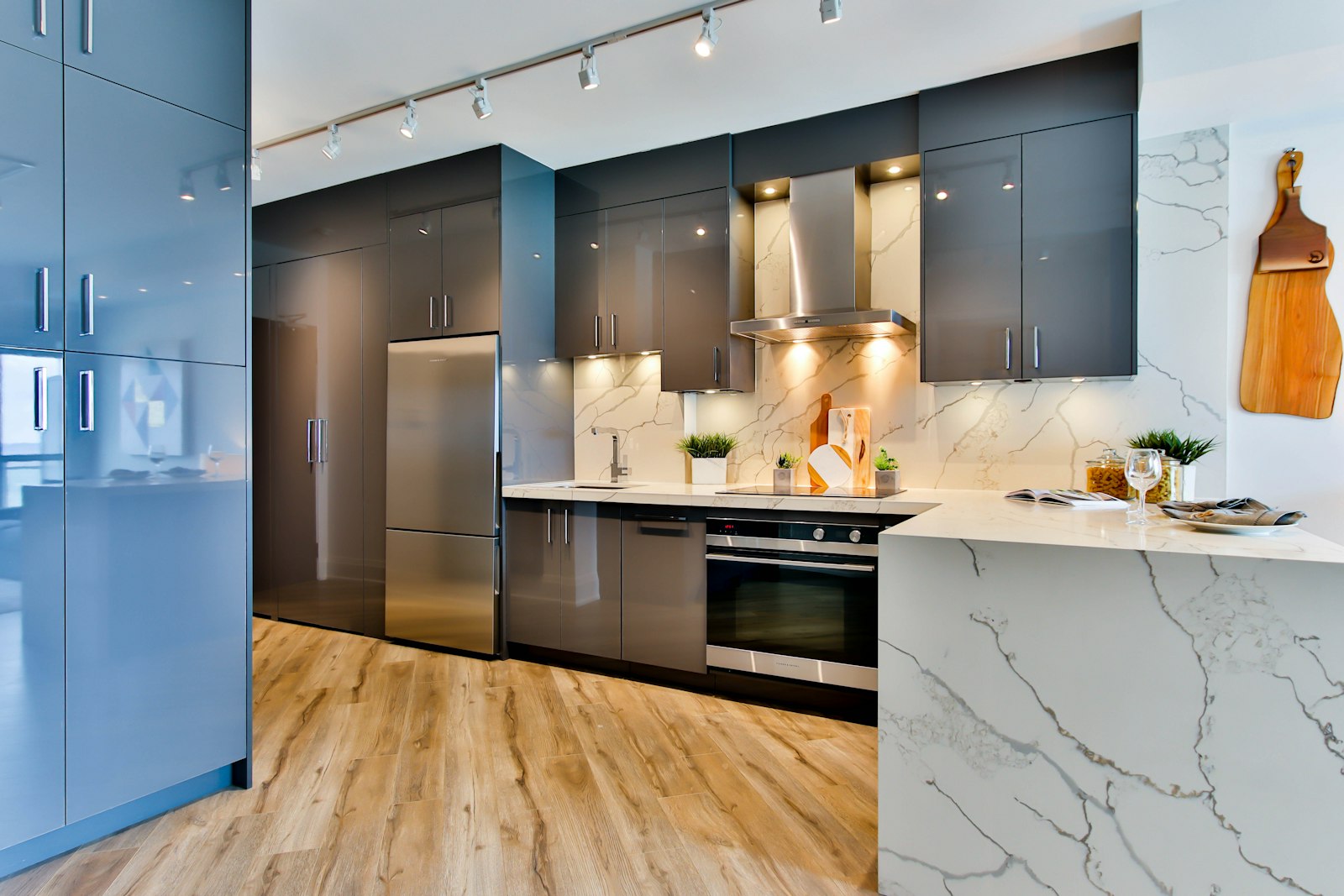
You set a hot pan down without thinking, wipe up a splash of lemon without a second glance, and the stone under your hand looks exactly as it did on day one. That is what the right worktop gives you. The wrong one gives you a dull ring, a pale mark or a nervous pause before every pan.
Picture a family in Währing, the eighteenth district, who are just planning their kitchen. They cook every day, elaborately at weekends, often with three pans at once. The daughter bakes bread, the son makes smoothies with lemons and berries. The mother wants a worktop that looks like pale Carrara marble. The father asks whether you can put a hot pan down on it without thinking. Both wishes are justified, but they lead to quite different materials.
Contents
- Why the worktop is the most important surface in the kitchen
- The three materials at a glance
- Dekton: the ultra-compact material
- Natural stone: unique, but not all natural stone is alike
- Quartz composite: uniform and easy to care for
- Thickness, edge and workmanship
- How to decide
- Frequently asked questions
- What happens next
Why the worktop is the most important surface in the kitchen
No surface in the home is used as hard as the worktop. Here things are cut, put down, kneaded, spilled and wiped, often several times a day. At the same time it is the defining design element of the kitchen, especially when it stands free in the room on an island.
The choice of material is therefore always a trade-off between looks and daily life. A material that looks wonderful but suffers from every squirt of lemon does not suit every family. A material that withstands everything but looks cold and uniform does not suit every room.
We therefore begin with questions about how you cook: are pans put straight from the hob onto the worktop? Is there a lot of work with acid, with citrus fruit, wine, vinegar, tomatoes? Is food cut directly on the surface or always on a board? How sensitive are you to visible signs of use?
A worktop does not have to stay flawless. It has to age in a way you like.
The showroom trap. Choosing from a photo in a showroom is how most worktop regrets begin. You live with the surface every day: every pan you hesitate over, every stain you scrub, every edge you flinch at. A worktop is also the one surface you cannot simply swap in a weekend. So what are the real differences?
The three materials at a glance
The table below shows the most important properties in direct comparison. The ratings are a guide; exact performance depends on type, finish and workmanship.
| Property | Dekton | Natural stone | Quartz composite |
|---|---|---|---|
| Heat resistance | very high | high, depending on type | limited, trivets needed |
| Scratch resistance | very high | granite high, marble low | high |
| Stain resistance | very high | depends on type and sealing | very high |
| Acid resistance | very high | granite good, marble sensitive | good |
| Edges | hard, but brittle | depending on type | robust |
| Repairability | limited | good, can be re-sanded | limited |
| UV resistance, outdoors | yes | depending on type | no |
| Look | uniform, wide choice | every slab is unique | uniform |
Dekton: the ultra-compact material
Dekton is an ultra-compact surface from the manufacturer Cosentino. The material is made from a mixture of mineral raw materials, of the kind used in glass, porcelain and quartz surfaces, compacted and sintered under very high pressure and very high temperatures. The result is a slab of extremely low porosity. How the material is made and where its limits lie is described in the article Dekton explained.
In daily use Dekton shows its strengths with heat, scratches and stains. A hot pan generally leaves no marks, nor does a knife. Red wine, coffee and oil do not penetrate. Because the material is UV-resistant, it is also suitable for outdoor kitchens, more on that in the article Outdoor kitchen on the terrace.
The weak point is the edges. Dekton is hard, but brittle. A hard blow from a cast-iron pot on the edge can cause a chip that can hardly be repaired invisibly. Edges are therefore usually slightly chamfered or rounded, and the work requires an experienced stonemasonry firm. With some designs the pattern is also not fully through-coloured, which can show at the edge. We check this when selecting samples.
Dekton comes in various thicknesses, and 12 or 20 millimetres are often used for worktops. The thin slabs look very light and elegant; the thicker ones are often the safer choice for large overhangs and islands. Natural stone, by contrast, offers something no factory can copy.
Natural stone: unique, but not all natural stone is alike
Natural stone is not a single material. The term covers rocks with completely different properties. For the kitchen, the most important distinction is between siliceous and calcareous rocks.
Granite and similar hard rocks are very hard, scratch-resistant and heat-resistant. With good sealing they are also stain-resistant. Granite was the standard worktop for decades, and for good reason.
Marble and limestone are softer and react to acid. A splash of lemon juice, vinegar or wine can leave a dull mark on polished marble, called etching. That is not a flaw of the material but its nature. In Italian kitchens marble has been used for centuries, and many people love precisely the patina it acquires over the years. Anyone expecting a flawless surface will not be happy with marble.
Quartzite is a very hard rock that often looks like marble. It combines the look of marble with considerably more robustness. However, softer stones are sometimes sold as quartzite too. A simple test on a sample provides clarity, and we do this before ordering.
The greatest advantage of natural stone is its uniqueness. Every slab is one of a kind, and so we choose the actual raw slab together with you at the stone yard. Another advantage: natural stone can be re-sanded and repolished. How natural stone behaves in daily use we also describe in the article on natural stone in the bathroom, where similar questions arise. Quartz composite offers the opposite: calm, and uniformity you can plan around.
Quartz composite: uniform and easy to care for
Quartz composite consists mostly of ground quartz, bound with resins and coloured with pigments. The material is low in pores, very stain-resistant and available in uniform colours and patterns. For many families it has been the obvious choice over the last twenty years.
Its weakness lies in the binder. Resin does not tolerate high temperatures. A hot pan straight from the oven can lead to discolouration or, in rare cases, cracks. With trivets that is no problem, but you have to remember them. In addition, the resin can yellow under UV light, which is why quartz composite is not suitable for outdoor kitchens.
The uniform look is both an advantage and a drawback. Anyone who wants a calm, consistent surface is well served by quartz composite. Anyone looking for the liveliness of natural stone will not find it here with the same depth. Material alone does not make the worktop, though. Thickness and edge decide the rest.
Thickness, edge and workmanship
Besides the material, thickness and edge treatment strongly determine the look of a worktop. A slim slab of 12 millimetres looks modern and light. A slab of 30 millimetres or more looks solid and classic. A common solution is a thin slab whose edge is visually strengthened by a strip mitred on. The slab then looks solid from the front, but stays lighter.
The cut-outs for sink and hob are part of the planning too. An undermounted sink looks more elegant than one set on top. A flush-fitted hob, such as a hob with an integrated extractor, requires precise routing. How such hobs work is explained in the article Hob with integrated extractor.
A practical point in Vienna: large worktops have to get into the building. In Gründerzeit buildings (the late-nineteenth-century apartment blocks) with narrow stairwells or small lifts, a slab 3.20 metres long can become a challenge. We therefore check the route early and plan butt joints where they are least noticeable. The template measurement for the worktop, incidentally, only takes place once the base units are installed, so that it fits to the millimetre. Which brings us to the decision itself.
How to decide
Back to our imagined family in Währing. The wish for a marble look and the wish for a slab on which you can put down a hot pan could not be reconciled with real marble. The solution was Dekton in a pale, marble-like design, 20 millimetres thick on the island with slightly chamfered edges. A sideboard in the dining area, which is hardly used, got a slab of real marble. So the mother has her stone, and the father his pan. Imagine the first Saturday morning: the father sets the pan down without a thought, the daughter kneads dough on the pale island, and the light from the window runs along the edge.
If you are facing the decision yourself, these steps help:
- Describe your cooking habits honestly. Hot pans, acid, cutting, baking, children.
- Clarify your tolerance for patina. Do you like signs of use, or does every mark bother you?
- Settle the look. Uniform or lively, light or dark, matt or polished.
- Test samples. Put lemon, red wine and oil on a sample and wipe it off after a few hours.
- Decide edges and thickness. To suit fronts, island and overhangs.
- Combine where it makes sense. A robust material for the work zone, a more delicate one for lightly used surfaces.
How the worktop plays with the fronts is described in the article Kitchen fronts compared. Which surfaces keep looking good in the long run you can read in the piece Easy to care for? An honest assessment. You will find the whole process in our guide to the fitted kitchen in Vienna, and how the worktop shows up in the budget in the article What does a fitted kitchen cost in Vienna. At Richard Atelier, the stone is fitted alongside the cabinets from our own joinery Tischlerkultur, in the Viennese tradition since 1935, and one person at Richard Atelier looks after the whole kitchen, start to finish. How we plan and build kitchens is shown on our page about fitted kitchens.
Frequently asked questions
Which worktop is the most robust?
Against heat, scratches, stains and UV light, an ultra-compact surface such as Dekton is overall the most robust choice. Granite is also very resistant. The weak point of Dekton is the edges, which can chip under hard blows. If you are torn between two, test samples in your own kitchen before you decide.
Can you put hot pans on a quartz composite worktop?
We advise against it. The resin in quartz composite does not tolerate high temperatures, and a hot pan can cause discolouration or, in rare cases, cracks. With trivets, however, quartz composite is a very easy-care worktop in daily life.
Is marble suitable as a kitchen worktop?
Marble is suitable if you accept its properties. It reacts to acid with dull marks and is softer than granite, but it develops a patina that many people value. Anyone who wants a permanently flawless surface is better advised to choose Dekton or quartzite. A sample at home shows quickly which camp you belong to.
What is the difference between Dekton and quartz composite?
Dekton is sintered from mineral raw materials under high pressure and high temperature and contains no resin as a binder. Quartz composite consists mostly of quartz bound with resin. That is why Dekton is heat- and UV-resistant, while quartz composite needs trivets and is not suitable for outdoors. We show you the difference on real samples.
How thick should a worktop be?
That depends on material, look and construction. With Dekton, 12 and 20 millimetres are common; with natural stone often 20 to 30 millimetres. For large overhangs on an island, thicker slabs or additional supporting structures are often the safer choice. We settle this for your island together.
Do natural stone worktops have to be sealed?
For most natural stones, sealing is recommended, as it slows the penetration of stains. Depending on the stone and the use, it has to be renewed at intervals. Against etching of marble by acid, however, sealing protects only to a limited extent. Your stonemason tells you exactly what your stone needs.